
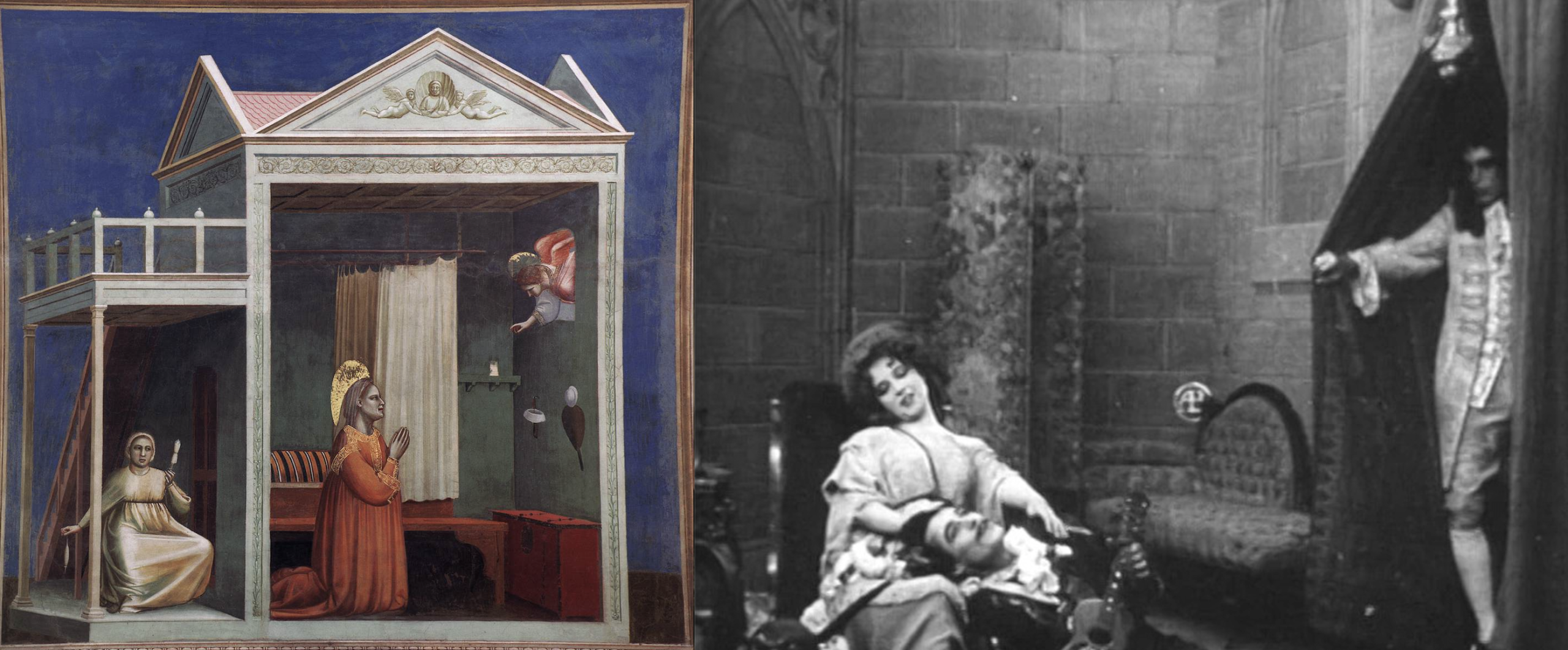
Something strange happens when we look at works by Giotto. The quality of their beauty is not complete and total but puzzling. We have to put aside what we think we know about how paintings speak, and instead learn how paintings learned to speak. This means a renegotiation with our visual language as such, a radical suspension of our familiarity with most pictorial strategies, a tapering of our expectations and a discovery of their suppositions. We embark on a similar, but distinct, experience when looking at the origins of narrative film, as well, in the work of D.W. Griffith. In both cases we experience a profound estrangement, an estrangement both to the figures and actions being represented and the means by which they’ve been represented. They’re on a threshold; bodies becoming images. In our engagement with these works we submit ourselves to their economies. Our vision and expectations are calibrated by the parameters of the techniques and visual languages they were pioneering. Implicit, but subdued, is an obligation to undergo the imaginative act of thinking of the nothing that came before them. We try recreate the gaze of those who first encountered them, to recall their mystery. Maurice Merleau-Ponty writes that “before expression, there is nothing but a vague fever, and only the work itself, completed and understood, will prove that there was something rather than nothing to be found there.” Their oeuvres are bound to this inarticulate nothing in a way that the later, more technically-developed works based on their discoveries are not. Thus, they make us historical subjects in a very unique way that the paintings of the High Renaissance or the Golden Age of Hollywood can’t. To paraphrase George Didi-Huberman’s approach, they task us with a paradox; to evoke the memory of a profound mystery, of the word becoming flesh, a memory of a miracle we never witnessed, but one that can nonetheless can lay claims to the future. Put another way, we don’t merely trace them back, but we also follow them forward. And so their works speak as much of their historical moment as they do our own, an experience we can recover as we attempt to traverse the distance between the two.
The suspension I’m talking about can be seen in a parallel play on light in Giotto’s fresco at the Bardi chapel of St. Francis’ trial by fire before the Sultan and in Griffith’s The Lonesdale Operator. The problematic both these works share is that of showing light and the absence of light. In Giotto’s fresco the orange conical at St. Francis feet doesn’t register as a fire at first glance. Fires glow. This warped shape seems like nothing but the contours of fabric Giotto was always so keen on painting. The gestures of the figures tell us what is going on. Francis maintains a courage while the onlookers shield themselves from this winding cone. It has a magnetism whose effects are seen in its push and pull. Giotto cannot show us the fires luminosity. He’s not painting with oils, which can be layered to create the effect of light modulating through a jewel or being filtered by a semi-transparent fabric as in a Van Eyck. We seem to learn to see in Giotto’s world through a series of inferences. John Ruskin put forth a different interpretation. He proposes another way of seeing the fire in this painting; “What his art can honestly do to make you feel as much as he wants you to feel, about this fire, he will do; and that studiously. That the fire be luminous or not, is no matter just now. But that the fire is hot, he would have you to know. [The picture] in at least six-sevenths of its area—is either crimson, gold, orange, purple, or white, all as warm as Giotto could paint them; and set off by minute spaces only of intense black. […] The whole picture is one glow.” So according to Ruskin there is luminance, a warmth dispersed everywhere, held stark by the contrast of the blue background. If we compare the whites in the Sultan’s sleeves to the whites on the pope’s assistant in the fresco just above it, though, we can see the hue is consistent. Ruskin’s interpretation is a stretch, but it goes straight to the heart of what is at stake in looking at these works; sharing in the imagination of the artist’s experimentations, which in this instance entails a defamiliarizing of the effects of fire and light.

We encounter a similar problem in a scene in Griffith’s The Lonesdale Operator when Blanche Sweet switches off a lamp. We see what Griffith would have us imagine as semi-darkness; he uses a blue tint to imply it. This darkness is as central to his story as the fire is to Giotto’s. The Lonesdale station is being robbed by two tramps. Help is on the way but not fast enough. Blanche Sweet, quick on her feet, finds a solution to buy some time. She turns the light off and in the darkness she holds a monkey wrench as if it were pistol at the two tramps as they smash down the door. They fall victim to her bluff and cower and hide. We do not share in the darkness necessary for this deception; we see the her pull the switch of the lamp and see the light turn from white to dark blue, and in this shade this we infer a darkness in which a deception takes place.
It would be misleading to attribute the awkwardness we experience to their primitive techniques. This is what Ruskin is trying to get at. It’s much more profound than a mere inadequacy; it’s the dawning of a new world. And in this new world of representation everything is unfamiliar. Naturally, the unprecedented proves incredibly difficult for the critic to work through in language. Ruskin undermines himself in his introduction to a book of reproductions of the Arena Chapel, when he answers the rhetorical question ‘Why is Giotto worth looking at?;’ “I answer, first, that in all matters relating to human intellect, it is a great thing to have hold of the root: that at least we ought to see it, and taste it, and handle it; for it often happens that the root is wholesome when the leaves, however fair, are useless or poisonous. In nine cases out of ten, the first expression of an idea is the most valuable: the idea may afterward be polished and softened, and made more attractive to the general eye; but the first expression of it has a freshness and brightness, like the flash of a native crystal compared to the lustre of glass that has been melted and cut.” Maybe this is his Victorianism, but to compare Giotto to a root in the sense of an untainted purity seems to me to be at odds with the seriousness his interpretations give the frescos. This only affirms the awkwardness, the unrefined qualities, as defects on a linear trajectory towards the High Renaissance. In other words, Ruskin’s comments imply that Giotto represents a naivety we ought to appreciate in an antiquated sense. To do so is to domesticate Giotto. At the heart of the naïve qualities in Giotto’s works (and Griffith’s) is an estrangement which is anything but naïve; I want to argue it’s traumatic. We sense in these works the contingency of our subjective apperception being appealed to, and in this way we find it recreated, materialized. As much as one perceives a familiarization of the world becoming visual, we’re nonetheless haunted by a concomitant de-familiarization, of the works being tethered to the nothingness they emerge from, of their uncertainty peering outwards beyond the horizon of the imaginable. As the works approach a similarity, we behold the synonymous dissimilarity, the uncanny lurking within them. Giotto’s work ushers in the era of humanism, an epochal shift that had fallen into crisis by the time Griffith arrives on the scene. Our relationship to their works is filtered through our unstable relationships to these historical transformations. This uncertainty can be paralyzing; I think on most days we wish we could turn the lights off, to remain in the undisturbed innocence of the pre-ordained.
Yet the possibility of a return and reconciliation to a divine order is never on the table in a Griffith film, even in their kitschiest moments. There isn’t any longer a primal condition to be estranged from, only an eternal homelessness. And so while he and Giotto faced similar problems (which they solved with a similar ingenuity), it is the differences in the dissimilarities their works invoke that will prove most illuminating. There is an unremarked upon passage in Walter Benjamin’s essay Das Kunstwerk im Zeitalter seiner technischen Reproduzierbarkeit, where he makes fun of Séverin-Mars, an actor who’d starred in Abel Gance’s J’Accuse and La Roué, for “speaking of the film as one might speak of paintings by Fra Angelico.” The statement Séverin-Mars had made is as follows; “What art has been granted a dream more poetical and more real at the same time! Approached in this fashion the film might represent an incomparable means of expression. Only the most high-minded persons, in the most perfect and mysterious moments of their lives, should be allowed to enter its ambience.” This anecdote presents us with the constellation I’ll attempt to work through in the following essay; early Renaissance painting, film, expression, mystery, ambience, and poetry. Benjamin tells us these concepts, mediums, effects, and transformations cannot be grasped on their own terms, but have to be placed in relation to one another and, most crucially, within the ongoing temporal dynamic of progress and regress in modern, industrial society. To dissolve this discrepancy is the tendency of the capitalist mode of production; it’s to place them both alongside one another within the empty chamber of homogenous time, and this robs them of their potential. Lukács György called this process of one-sided a‑historicization reification. The dialectical twist is that it is only within reification that art works can speak anything true of our world, by making critical use of the contradiction, exploding the continuüm of time being endlessly absorbed and estranged. When history can be reified critically, the manifest qualities of a fresco in an Italian Monastery from the Trecento can speak to the figures moving in a motion picture inside a retrofit theatre in Manhattan at the dawn of the 20th Century. In the critical reification of history artworks can be registered politically, because they can throw one another into critical relief.
Textiles and Distinction
We can never know what did Giotto looked at. The Florentine landscape, market places, Byzantine mosaics, sculpted reliefs, cathedrals, and of course his master Cimabue’s altarpieces. But the even greater mystery is the chasm between the world he saw with his eyes and the one he represented with his hands. The emergent issue Giotto faced, that self-assigned task he intuited from a primordial blur, was that of distinction, of separating bodies from one another and the space around them. How to give them contours, emotions, movements, all in the service of a narrative? He turned painting into an art of story-telling, and it was a matter of orchestration, of choreographing bodies and condensing movements into a single moment so that they could imply a larger, ongoing revelation. The stories were already known, there was no invention on Giotto’s part in this respect. It was a matter of rendering them pictorially, of a flight towards something essential by a representation of the particulars. To do so necessitated looking. Again, I’ll quote Ruskin; “One of quite the first results of Giotto’s simply looking at things as they were, was his finding out that a red thing was red, and a brown thing brown, and a white thing white—all over.” Ruskin is here distinguishing Giotto’s naturalism and his use of color from the excessive gold-leafing of the decorative byzantine style, but his assessment begs an obvious question: is it really a matter of discovering the visual correlation between a red thing and red paint, or was it something more difficult? Certainly it began through observation, this much we can agree on. But it wasn’t merely a matter of just seeing so much as it was discovering how he saw, of learning to objectify the experience of seeing inside a frame. To know that one sees is one thing, to learn how vision can find itself reproduced in paint on a wall is something altogether different. This entails the alienation of vision, an alienation that coincides with its discovery. Erwin Panofsky called this “an objectification of the subjective.” This is the dialectical loss of innocence we behold in his work and its discoveries; the departure out of the long durée of the dark middle-ages. This departure cannot be explained by Giotto’s intuition alone. The precondition for such a discovery was the elevated status of human reason, as represented by figures like Thomas Aquinas and Albertus Magnus. The engagement with the divine underwent a discursive shift; it was no longer mediated through theological terms but by the metaphysics of man and the natural world. The gift of reason that God endowed man with was finally being used. The ongoing consequences of this transformation were not to be fully realized until the enlightenment in bourgeois society, but we can see its origins germinating in Giotto’s frescoes. Eugenio Battisti writes, “From now on the heroes of biblical and sacred history appeared on a real stage (anticipating the scenography of sacred plays), and a stage so well defined spatially as to locate the action in a fully developed architectonic and atmospheric setting. The result was impressive the sacred scene, unexpectedly removed from the supernatural plane, was brought to earth, brought into the home, into daily life, almost as if to show that the gap between the sacred and profane was very slight.” This dialectical inversion elevates man to a thinking, reflecting being, and in turn humanizes the divine. Man, who once lived on the peripheries, achieves for himself a more central role; he can now move in ways he couldn’t before. Panofsky describes the emergence of this process as follows; “Perspective, in transforming the ousia (reality) into the phainomenon (appearance), seems to reduce the divine to a mere subject matter for human consciousness; but for that very reason, conversely, it expands human consciousness into a vessel for the divine. It is thus no accident if this perspectival view of space has already succeeded twice in the course of the evolution of art: the first time as the sign of an ending, when antique theocracy crumbled; the second time as the sign of a beginning, when modern “anthropocracy” first reared itself.” For many this transformation was hubris, blasphemy. A scene from Roberto Rossellini’s L’età di Cosimo de Medici wonderfully illustrates this point.
“Masaccio’s liberty is the liberty of man. His is a new form of expression. He has freed himself from the slavery of habit. If you don’t understand this painting, it means you are still its slave.” The sister doesn’t see “the magnificence of christ” or his divine power; he’s too human. Alberti explains, “The artisans have always depicted a glorious, immense and infinite God in accordance with a holy tradition. But Masaccio has painted the body of Christ like that of a man; Christ made himself man and Masaccio looked at his humanity. And by means of this reality made flesh he helps us adore his divinity.” The centrality of vision to this story isn’t something that was given, but had to be fought for, had to be discovered. Giotto’s struggle was to pioneer this potential. The viewer is implicated in a process of envisioning, and we are introduced to our imaginative faculties. They have a newfound strength. Faith depends on reason, and looking has consequences.
G.W.F. Hegel was suspicious of these “figures being brought to earth.” In his Lectures on Aesthetics he wrote; “What was relatively lost in Giotto’s attempts was that splendid holy seriousness which had been the basis of the previous stage of art. The world wins a place and development, as after all, Giotto, true to the sense of his age, gave a place to the burlesque as well as to the pathetic.” Thus, Giotto instigates a sacrilegious threat for some and a pathetic inadequacy for others. For Ruskin he’s an end in itself, for Hegel he didn’t hardly get going. The burlesque is certainly what ties Giotto and Griffith’s work together. There is an over-dramatization, likely an uncertainty of the audience’s capacity to decipher the implied narrative. But we need to learn to see as beautiful what is necessary in this development. The audience is learning to see as the painter is learning to paint; there are bound to be exaggerations, steps taken too far. But a diminution on this basis alone seems to me to repress the most vital elements of their work, which is a reverent faith in their medium’s capacity to communicate that which it had not been able to before, a faith in man’s ability to perceive as he hadn’t before. And so we have to see in the pathetic moments a courageous attempt to imbue value in that which had been deemed unworthy.
To give an independent existence to the figures interacting with one another in his pictures necessitated distinguishing them from one another. Each character exists in their own world. Emoting, thinking, feeling, sleeping, dreaming, acting and reacting. They have their own lives. Their interactions are significant because the figures have a determinate subject-hood about themselves. They all play a role in an unfolding drama. The gestures and compositions that most studies focus on are not the only way the figures achieve a pictorial subject-hood. Giotto gives life and individuality in his rendering of fabrics. All of his characters are wrapped in cloaks and tunics of many colors, all of them are shielded from one another. It’s their independence, a corporeal distinction of the body inside and a demarcation from the world around them. The shadows in the folds give the figures volume and depth; it’s an envelope hanging down around them under the weight of the gravity the figures are also bound by. The cloaks themselves are exaggerated costumes, no doubt. They’re not the historical garbs the figures would have worn, nor are they the clothing of his contemporary Florence. But Giotto’s handling of the fabrics never exaggerates. The draping textiles always follow the most strict rules of nature to achieve the status of an intermediary. Fabrics move, they readjust when we get up and sit down, they stretch along with us and give an indication of the limbs they cover and which also protrude out. They have primarily shape and weight, they display this in their modulation of light and shadow. This implication of dimensionality is crucial. And their representation is where Giotto discovered paints malleability, its liquidity. Textiles were everywhere in Florence at the turn of the 14th Century. They was the primary export and chief engine of the Florentine economy, then on its way to becoming the largest in the world. Wool was imported from England and France and then manufactured by the weaving and dying guilds, which were by and large the most powerful guilds in the city, employing at one point up to 9,000 workers. Maybe therein lies some secret about Giotto’s discovery of the brown and red Ruskin wrote about; maybe his experimentations in color were informed by observing members of the Arte di Calimala at work. Seeing textiles manufactured, from a bundle of raw wool to being woven, dyed, hung to dry washed and finally displayed as a sheet; it’s an almost alchemical process. Sheep appear in Giotto’s panels depicting Joachim in the wilderness; he was a shepherd. Giorgio Vasari’s biography tells us Giotto, too, was a shepherd. He was visited one day by Cimabue, who had been crossing through the fields between Fiesole and Florence. He saw a young Giotto watching over his flock, engraving the image of a sheep with “a pointed rock upon a smooth and polished stone.” Impressed by his prodigious skill, Cimabue took him on as an apprentice. Of course this story is likely a myth, but I like to think Giotto’s relationship to sheep and his treatment of fabric inspired Vasari’s fanciful imagination.
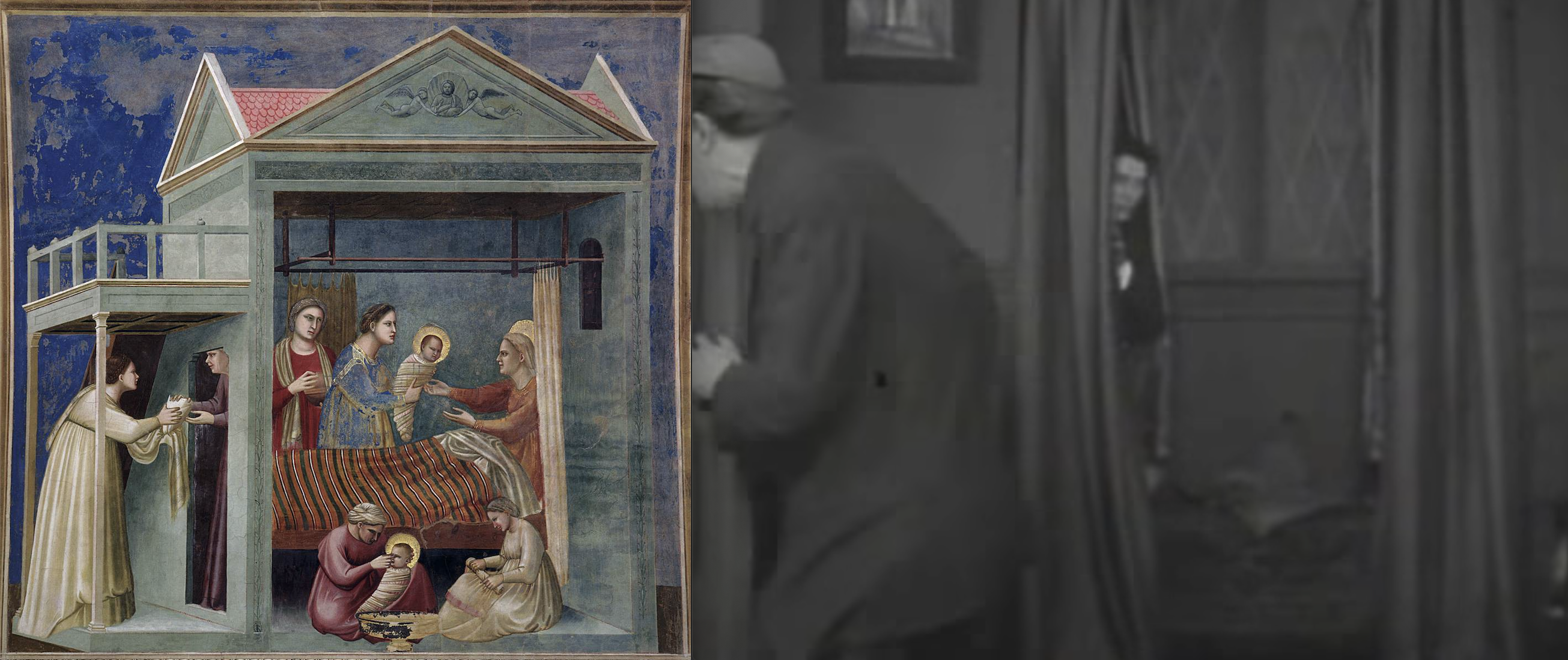
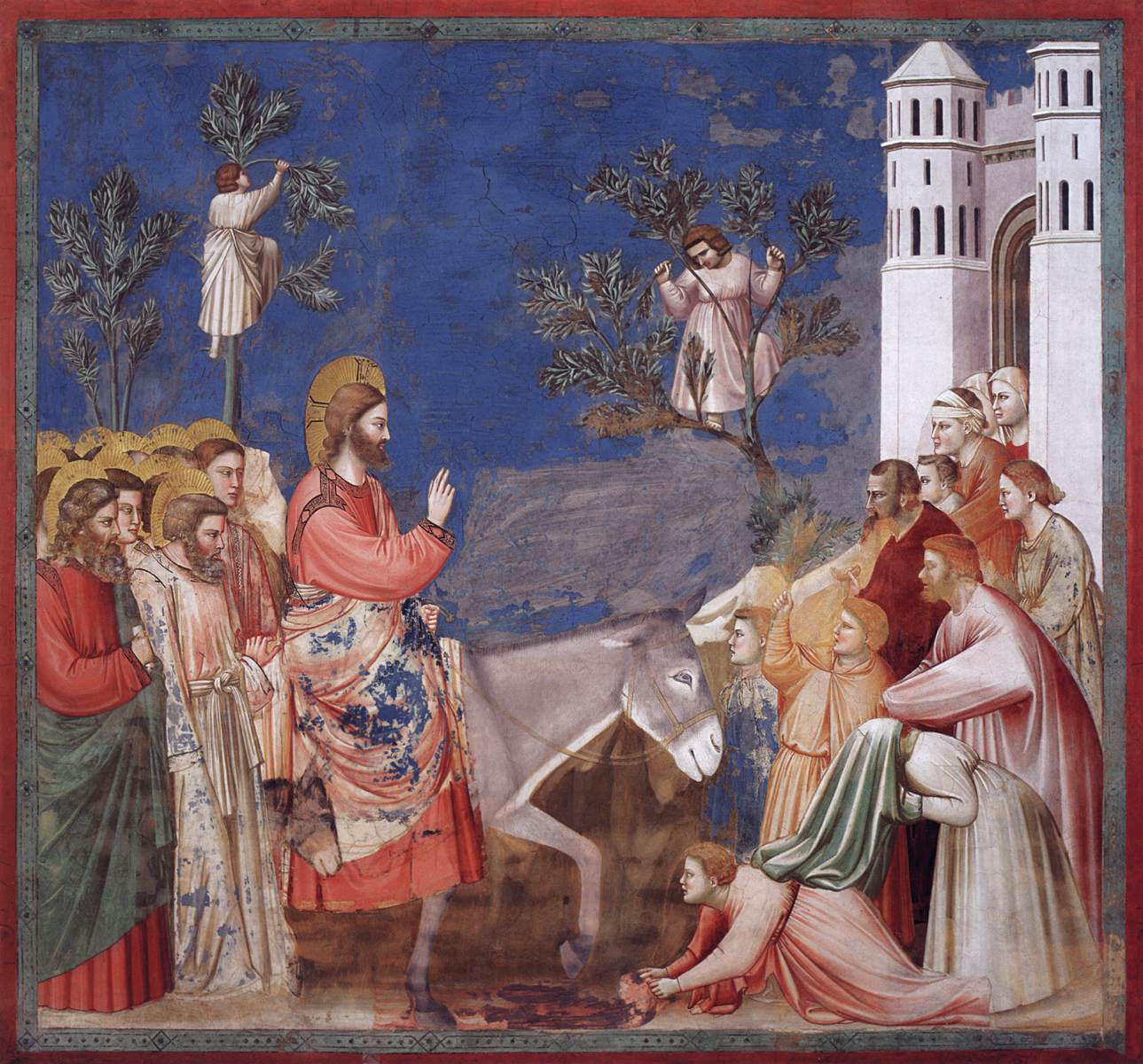
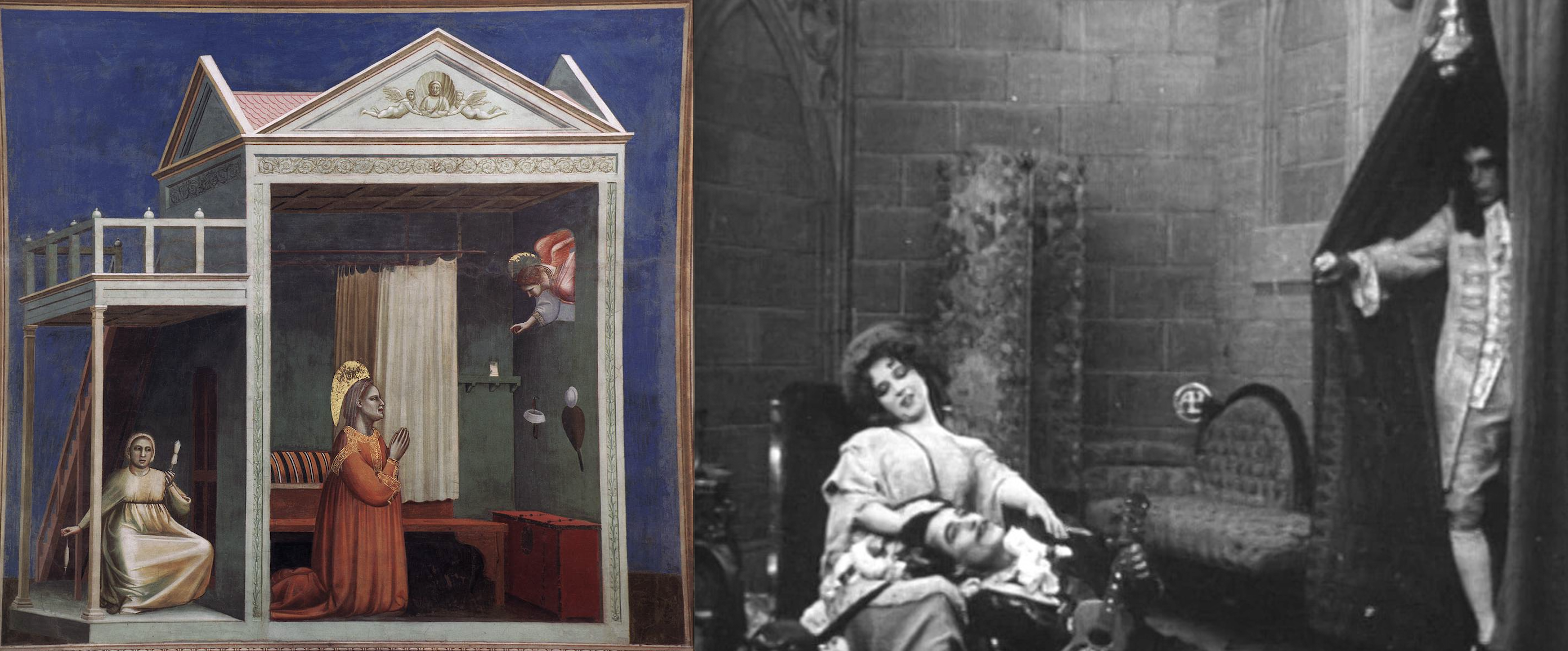
At the Padua Chapel we see a couple of frescos in which fabric plays a crucial role. Beginning in the fresco depicting Anna being visited by an angel we see her servant outside spinning yarn and a curtain partially drawn around Anna’s bed. Later, when Joachim returns another servant holds a towel. In the birth of the Virgin we see Anna’s bedroom again, this time with the curtains drawn. A gift is being handed to a servant, wrapped in fabric. The baby Mary is shown twice, both times wrapped in swaddling clothes, and alongside the version of Mary at the bottom we see a servant either rolling or unrolling some fabric. Textiles literally enfold, in representations they stage a relationship between their outer appearance and that which is concealed beneath. A synecdoche for the process of representation itself, a beautiful excess, a liquid malleable, fabrics imply both movement and stasis. They play another central role in the fresco showing Jesus entering Jerusalem on a donkey. One of the townspeople holds a branch we assume him to be laying down, and three of the characters can be seen at various stages of disrobing, one of them laying his shirt at the feet of the donkey. His cloak is turned into a smear. Whether or not it had more detail which has since faded I cannot say. Another of the townspeople is beginning to pull his arm out of its sleeve getting ready to disrobe. In between these two is a character with his head stuck in the process of taking off his green dress. It hangs around his neck, leaving him in-between worlds. We don’t see him and he doesn’t see anyone else for this moment. I’m not sure if Giotto meant this as a moment of comic relief, it’s not likely. Nothing demonstrates the burlesque quality Hegel condemned more than this figure. He’s turned inside out, a bit stupid, stuck here like this. But if we consider it as mere form, as a modulation of highlights and shadows, with folds that indicate gravity, we can see it echoing in a chorus of the cloaks around it, all of them with a serious utilitarian purpose. The shape of the green dress crucially mimics the triangular composition of the townspeople welcoming Jesus; there is no doubt an absolute seriousness about it. Giotto, who was so keen on following the facts of life and the mediation of appearances, knew that he had to pass through this balance between the seriousness of the divine and the comic-awkwardness of human bodies at the same time. Doesn’t part of the process of bringing the divine into the realm of the human necessitate an appreciation of precisely these very human qualities?

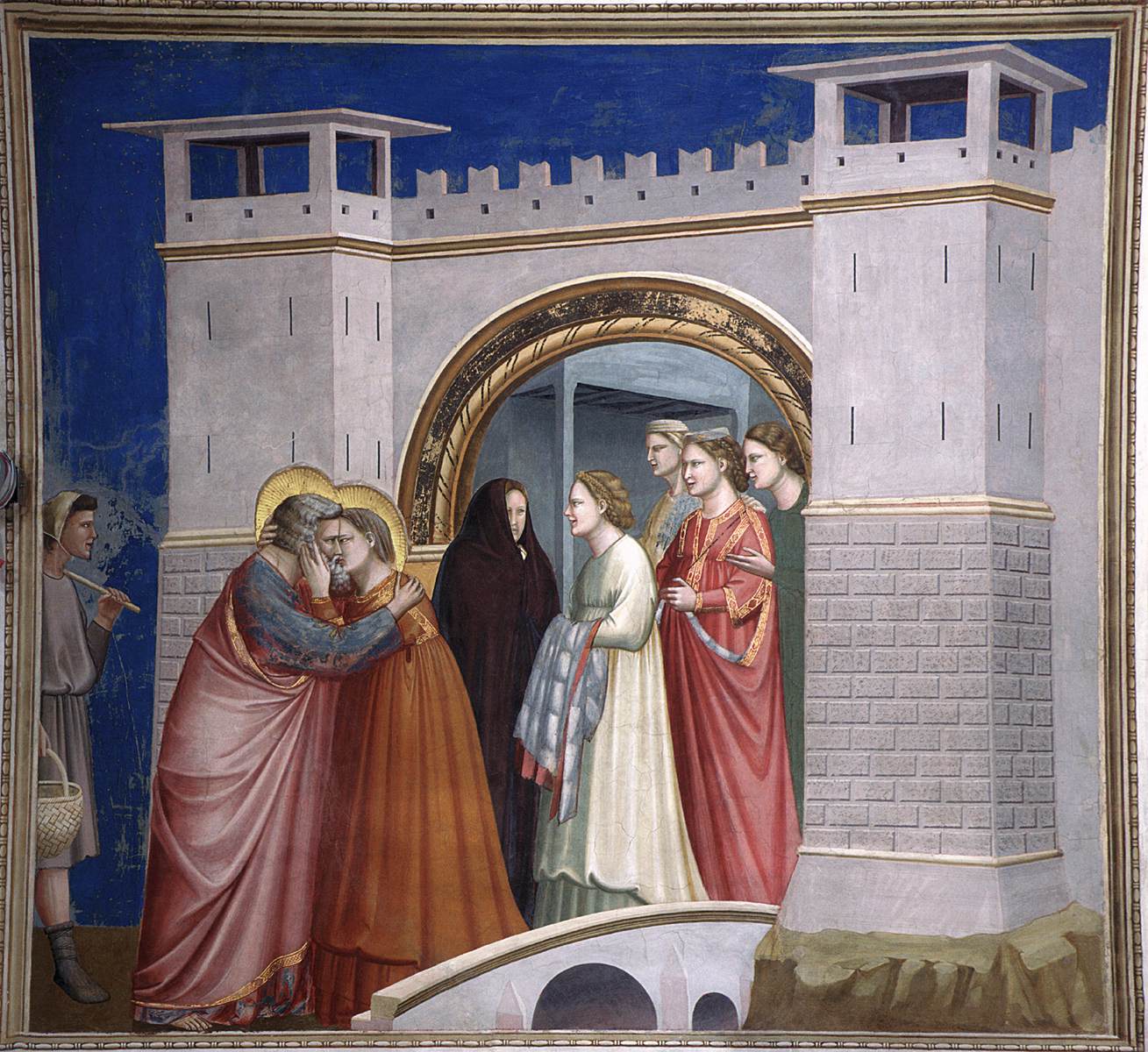


A similar element of inwardness, of a character closed off from the world, is represented in Joachim’s Dream. Joachim is almost entirely wrapped in his cloak, asleep and possible dreaming. It is a solemn scene, we cannot know what is going on in his head. There’s an angel bringing news that Joachim’s wife Anna will bare him a child. His deep interiority becomes more all the more vulnerable by the foreshadowing of its disruption. The highlights on his hands and forearms, his shoulder and left knee, the depths in the folds by his groin, are exquisite. These volumes stand out against the black emptiness of a shed, something like a womb Joachim might be wishing to return to, might be dreaming of in his unbounded silence. His heaviness implies as much. The stretch of his pink cloak between his left knee and left arm is taunt. It is pulled under his right arm, and the fold likely continues down to his groin. It’s clinging to him everywhere. There is something embryonic about this pink mass, like the swaddling bands his daughter Mary will be wrapped in, which hold a baby’s body tightly, simulating the enclosure of the womb. The freedom of a total movement is too much at first, the process of a corporeal expansion has to be learned in stages.

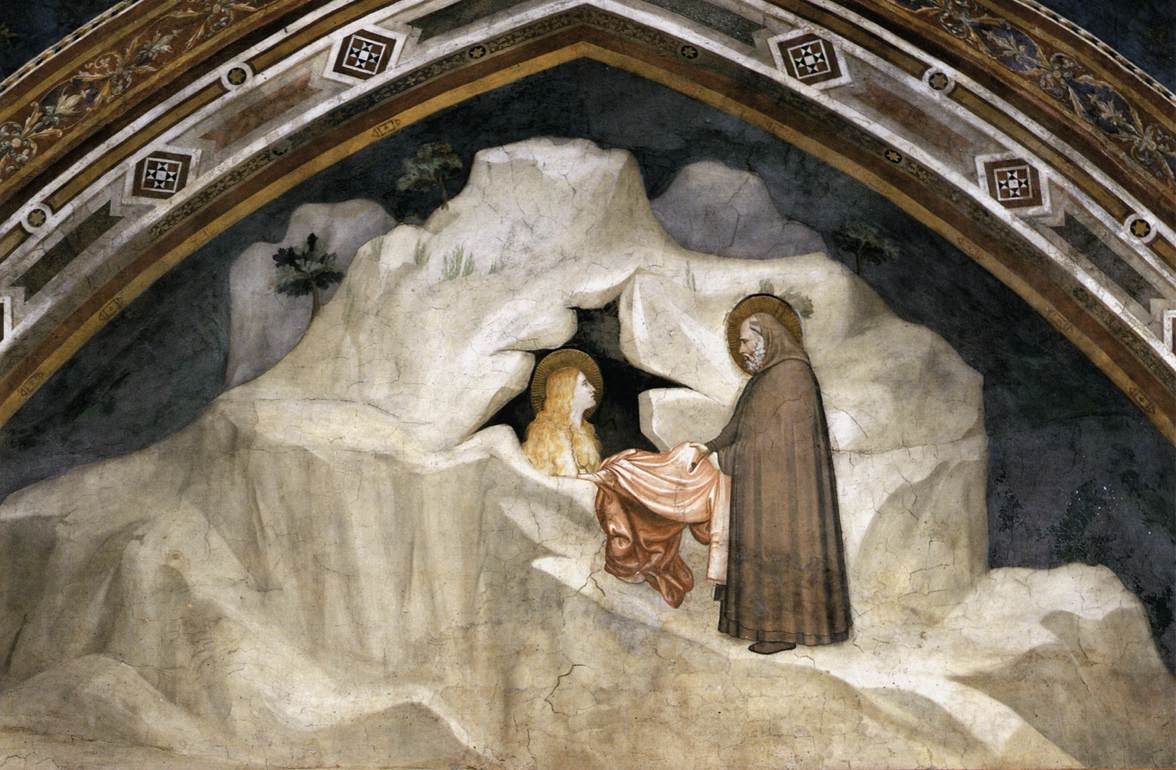
There are countless examples of figures retreating into fabric in Griffith’s films; An Awful Moment, Betrayed by a Handprint, Pippa Passes, A Lonely Villa, and The Burglar’s Dilemma, to name a few. A character will hide behind a curtain unbeknownst to another character entering a room. We see what the new character cannot see, a bulge implying a figure. Griffith would build tension in this way, playing off what we, the audience, know in relation to what his characters don’t know. He makes a relationship felt through this interplay of showing and hiding. The audience is dispersed amidst the characters, omniscient in a way, but also vulnerable, bounded to the unfolding drama. Linens line the tables of fancy restaurants, characters are presented in all kinds of historical outfits (often mis-sized), there’s of course the nightmarish costumes worn by the Klu-Klux-Klan, a miser hides his safe under a rug, but textiles rarely play so important a role in Griffith’s story-telling as they do in Giotto’s. The fabrics in Griffith’s The Song of the Shirt are in sharp contrast to those in Giotto’s fresco depicting The Hermit Zosimus Giving a Cloak to Magdalene in Assisi. Compared alongside one another, they illuminates the status of the material in their respective economies. In Giotto’s fresco the monk Zosimus encounters Mary in the desert, naked, hiding in a cave. He clothes her. She can come out; the possibility of a reconciliation emerges, fabric can play its penultimate role –as Giotto’s understands it– by granting Mary the ability to enter the world. It bestows her subject-hood upon her. In Griffith’s world the use-function of textiles has been utterly usurped by their exchange-value. In The Song of the Shirt Florence Lawrence sews madly to make enough money to take care of her dying sister. She’s frantic, shaking. Her stitching isn’t up to par and the merchant refuses to buy her handiwork. She brings it to the merchant’s boss, exposing the seems, begging him to accept. She’s desperate for money. He refuses. Returning to home she finds her sister has passed. «O, men, with sisters dear! /O, men, with mothers and wives! /It is not linen you’re wearing out, But human creatures› lives! /Stitch—stitch—stitch, /In poverty, hunger and dirt, /Sewing at once, with a double thread, /A Shroud as well as a Shirt.” In Griffith’s world textiles are not just a material but a commodity, they have a use-value and an exchange-value. They’re sewn together with a double thread. Fabric exists to be sold for money. It’s an intermediary between the characters and the world, an inverted mediation, a brutal social relation. In Griffith’s world characters are dominated by fabrics.

Angels and Entombment
Aside from the burlesque and overly-exaggerated gestures, the most pronounced correlation between Giotto and Griffith’s works is the architecture and scenery comprising their backgrounds, which are reminiscent of a proscenium stage set with its fourth wall cut out. The spaces the characters find themselves in are as important to their stories as the characters movements within them. Giotto’s figures move from left to right; there’s a foreground and a background, movement and continuity. The fabrics by which they distinguish themselves are all contained within a larger universe. Roger Fry writes, “The space in which the figures move is treated almost as in à bas-relief, of which they occupy a preponderant part.” No doubt Giotto’s compositions were based on the reliefs he’d have been familiar with, but his ability to give the scenes a background, a jouissance of details, imbues them with a dimensionality. The most obvious example is the rich blue of the sky in the Arena Chapel. It contrasts against the grey earth; they indicate boundaries, the eternal and the temporal, the divine and the earthly. These formal elements are “part of the picture’s teaching,” T.J. Clark tells us. Marcel Proust described the blue of the sky as «so blue that it seems as if the radiant daylight had crossed the threshold with the human visitor in order to give its pure sky a momentary breather in the coolness and shade.” There is a radiance, but I always intuited the blue as a kind of twilight. It’s too rich a blue for the sun to be penetrating through it. Whether or not the blue proposes a dawn or dusk is irrelevant. The atmosphere it induces is a hazy, nearly dreamlike state, as though it’s figures and beholders are on the threshold of consciousness. In the scenes of Joachim we see, indeed, a threshold; the foot of a cliff. This precipice implies that our position as viewers is an abyss, somewhere primordial. And there isn’t a horizon in Giotto’s work, there isn’t an end-point our eyes can disappear into. This absence lead Yves Bonnefoy to argue that that Giotto did not discover a spatial schemata so much as he “truly rediscovers human gestures and human time,” placing the characters “within a temporality of finitude and death (and even error and sinfulness), in order to conquer death and nevertheless to also conquer time.” It’s this ongoing pursuit Giotto pioneered, an event from which we’ve never stopped recoiling, a process art never stops reinventing; to understand figures in time, as partial semblances of a whole, as fragments in an unfolding totality. Bonnefoy’s prose is worth quoting at length. “Prior to perspective, which is a hypothetical way of reducing the object to its position in space, the way of representing things was metaphorical and mythical. I mean that the painter would evoke the object through some aspect of the appearance, freely chosen for its analogical character, for the resemblance it bore to the essence he attributed to the object. A rapid sketch of a bird’s profile seemed a legitimate way of naming it, just as the Egyptian hieroglyph was assumed to have done. The stonemason’s scrollwork rendered, through analogy, far more than the external appearance of the vine: it conveyed its inner movement, its temporal élan, in short, its “soul.” And the colors themselves, which derived a spiritual and symbolic aura from the gold background, signified not the accidental, fleeting aspect, which is no more than a phantom, but the specific virtue of the thing, the invisible core which, even in day-to-day life, is the only reality. Is this not, after all, the way we see? We do not see the qualities of a thing but its totality, its look. We attend to aspects of its appearance that we like or dislike, and then, as did the painters of old, we make our own fable of its reality in the space of our minds. But perspective denies this. The effect of bringing precision to the category of space—or perhaps, simply, the concern to think space, separating out spatial perception from our global intuition of reality— fosters an equally futile precision in all aspects of external appearance. In a word, the analysis of sensory qualities replaces the intuition of a fundamental unity. The relation of the image to the model it imitates is reduced to that between a definition, or concept, and a thing. An art of the manifest gives way to conceptual speculation, certainty gives way to hypothesis forever in search of ultimate confirmation. This is the dilemma of perspective, and suddenly that of art itself. Able to render the multiple aspects of a thing, art is, in a sense, the harbinger of reality; but it also, immediately, loses track of reality.” This is the trauma Giotto evokes, the discovery of the meeting point between finitude and the infinite; of grasping the divinely infinite within a human temporality of finitude. To no longer name something outside a picture but to cull its likeness within it. The progression of art from Giotto onwards to a more illusionistic representation of space coincides with the Copernican revolution; this much we can get our heads around. It has a bravado clarity, it seeks to realize the rules of geometry of its goal. But Giotto’s discovery is indeed traumatic insofar as in it time emerges from a hitherto unknown durée; a visual encounter with conflicting temporal orders. Time stands naked. Joachim is lonely in the desert; rejected, kneeling, dreaming, outside a shed too small for him to go into.
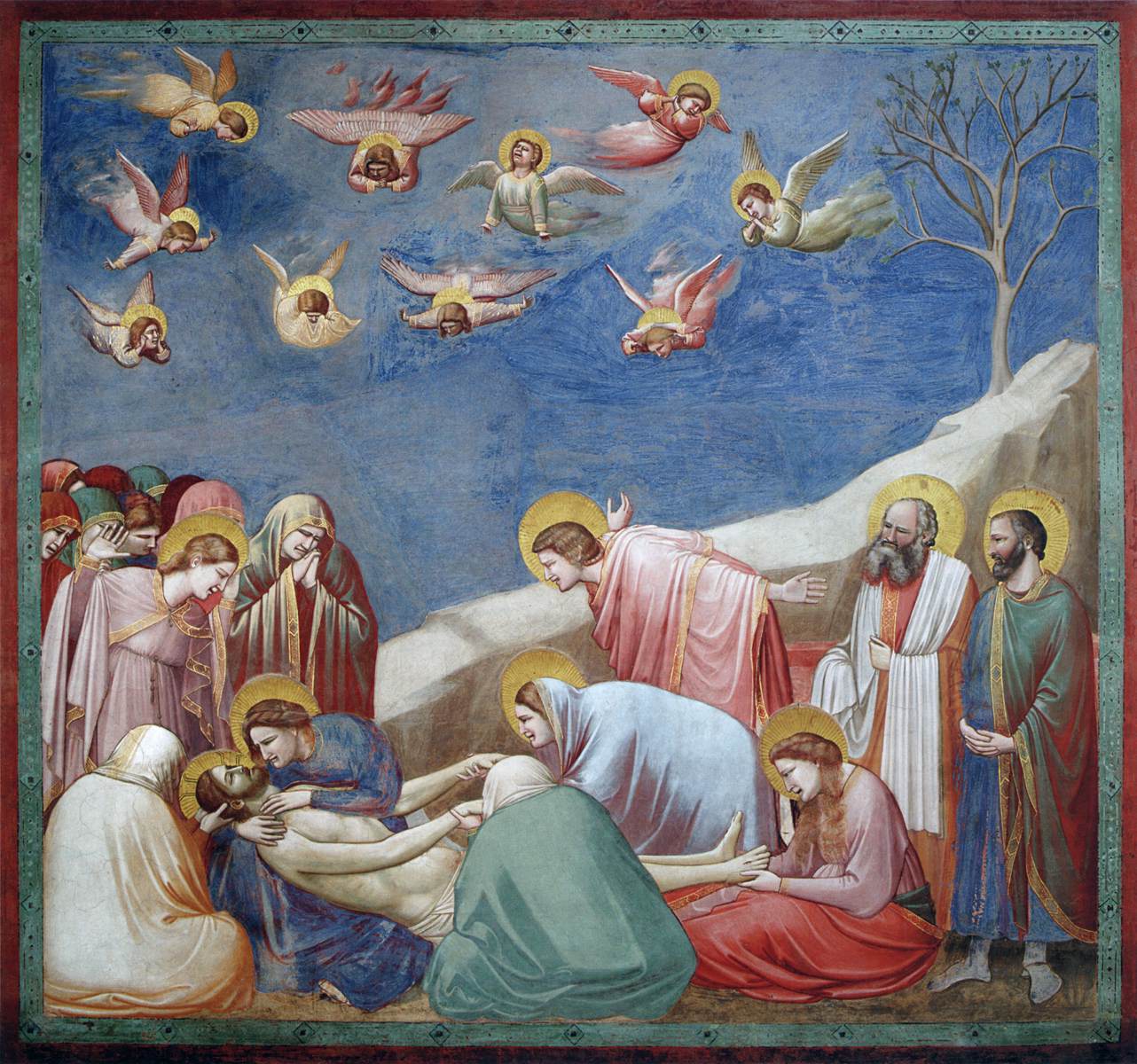
There are ruptures to these divisions; the angels. Part divine, part human, they can traverse between worlds. The blur of their tails evince their manifestation ‘in time.’ The angels appear twice to Joachim; once during his sacrifice of a lamb and another in his dream. “Becoming an image to spell out God’s message a second time” is how Clark describes them. They’re abstract and real figures simultaneously. Proust wrote that, “For all the celestial fervour, or at least the childlike obedience and application, with which their minuscule hands are joined, they are represented in the Arena chapel as winged creatures of a particular species that had really existed, that must have figured in the natural history of biblical and apostolic times.” Giotto’s realism, his naturalism, separates and collapses the distance between us and the world beyond. When an angel appears to Anna bringing news of her pregnancy he enters through the window. In the angel’s lamentations at the scene of Jesus’ burial Peter stretches out his arms, as though mimicking them. There are scenes which show meteors. In the fresco of Joachim’s sacrifice the divine hand of providence breaks through the heavens, and in Jesus’s baptism the figure of God ruptures through the ethereal blue with his heavenly glow. It’s not just these moments, though, that tether Giotto’s works to the world beyond. As I’ve tried to emphasize, it’s the characters semi-awkwardness, their uncertainty, which we are both familiar with and distant from that evokes this mystery of painting. It’s an uncertainty, a thought proposed not fully determined.
The problematic of representing space for Griffith was much different. One the one hand the camera renders perspectival space automatically, his dilemma was that of registering continuity between one space and another within the timespan of the unfolding film. Before Giotto there were illuminated manuscripts and mosaics. Before Griffith there was ‘canned theatre;’ actors telling a story in a fixed space from a fixed view. Griffith gave this movement; the camera conjoined spaces within a drama that had been separate. His intuition was to mobilize the camera’s story-telling capacity beyond the proscenium model. The viewer can travel on a journey with the camera as it moves from one location to another. The guiding principle of the film can hold these places together when properly handled. And there is an emptiness at the core of this principle. For instance in The Adventures of Dollie, the first film he made for Biograph, a girl is kidnapped and stuffed into a barrel by a pair of wandering ‘gypsies’ who carry her away in their wagon. While crossing a river the barrel falls out. The girl inside (we presume) drifts out of the frame to the left and is carried down the current of the river of rapids and a waterfall, always diagonally across the frame from the left to the right, from the background into the foreground. These three minutes of the film are a mystery. A young boy fishing happens to catch the barrel in his hook, and he reels her in just in time for the father to arrive. This continuous shot lasts two minutes long; at about 1 minute and 30 seconds in the barrel is cracked open and the little girl is taken out. This confirms our assumption that she’d been in the barrel the whole trip down the river, through the rapids and down the falls. The scene where she is rescued is significant for being the same locale (the second shot, though framed slightly differently) where the film had begun, where the family had been picnicking when the ‘gypsy’ attempted to pawn off some items only to be rejected, thus spurning him. The little girl is what moves the plot forward. The viewer learned to follow her, to understand himself situated in the next shot within the framework of the story, to accept the shift in locale because the object moving through them is whats important. And there is a nothingness in this, a suspension when the girl is inside the barrel getting tossed around. Whether or not she is or isn’t in the barrel is beside the point; the implication is enough to suspend belief. The final shot is sustained so long she might as well have been in it the whole time.
The temporal construction of space at the heart of the cinematic, the deep and mysterious relationships Griffith was uncovering, is raised to a nearly self-reflexive level in The Sealed Room. A king constructs an alcove for his lover but is suspicious of her fidelity. He catches her in the act of romancing one of his court musicians in the alcove he’s just finished having built. We see him peer into the room; we see that he’s seen them, but we also see that they haven’t been seen and are lost in their romance. There are two sets of awarenesses present, not including ours. Previously we’d seen them elope together, we knew of their affair and knew that the king didn’t know. But now we know that he knows and that they don’t know he knows. The king is furious and the rest of the film is cut across a vertical axis, the only door to the alcove. He pulls out his sword and thinks to slaughter them, but then comes up with a more sinister plan. He orders the construction workers to close off the single door to the alcove with bricks and mortar, sealing the lovers up inside. When they decide to leave they pull back the curtain and discover the wall and their fate. The king is full of jouissance and slashes as the wall with his sword. We cut from left to right, from inside the sealed chamber to the king dancing just outside it. This thin boundary which has sealed their fate is incorporated into the film as a spatial motif around which the action is framed. Entombment is a primal fear, but its expression takes on a macabre character in the 19th Century. In Balzac’s La Grande Bretèche a young traveler happens upon an abandoned mansion and enjoys some melancholy hours in the ruins of its gardens. He receives a letter, an order from a lawyer handling the estate, forbidding his reentry. Curious about its past, he visits with the lawyer to learn why it fell into ruin, but the lawyer can only tell him so much. He has to ask around. He discovers the innkeeper was the former maid to the madame of the mansion, who fills in the rest of the missing pieces of the story. The madame had a lover. When the husband suspected his hiding in the cupboard the wife denied it and forbid him to look inside, to which he conceded, only then to have the cupboard sealed, trapping the lover inside. The madame later wrote in her will that the house was to remain vacant after her death. The mystery is the unfolding of the story, the limits of each storyteller’s knowledge, the young man’s persistence in uncovering it, the haunted origins coming to light. Poe’s Cask of Amontillado is even more sinister, a story of a revenge and a drunken wino’s descent into a catacomb cellar, damp with nitro hanging from the ceiling like moss. He’s coaxed; the villain-protagonist’s motives aren’t so clear. The eerie mode and scintillating atmosphere seem to be the subject of the work. The question for Griffith is how this story of entombment could be told through film. He had to forego the multi-faceted narratorial plot of Balzac’s version but kept its account of the courtly affair, and chose recreate the atmospheric tone of Poe’s by means of mis-en-scene. The characters walk in and out of rooms; the set itself becomes a character, the unforgivable and indomitable matter of concrete traps the lovers inside. They pound at the wall. We shift to the other side; the viewer sees the victims and the aggressor on opposing sides of the sealed doorway. The shots of the trapped lovers are slightly more zoomed out than that of the king; he lords over them and their fate. We’re both locked in with them and outside with the vengeful king. Cinema traverses space.

Griffith’s What’s Your Hurry creates a spatial schemata that is something of an inverse to the entombment of The Sealed Room. A young suitor is scared of the father of the girl he is courting. In scene after scene he accidentally bumps into him; the first few times the father is carrying and showing off a new shotgun he received as a present. The boy’s guilt tells him that it will be used on him. He cowers and runs, but every time the scene changes we see him again, walking and unintentionally running into the father. The comedy works because the schemata laid out by Griffith is so improbable. You could never run into a person this many times, but thanks to the cut this seems to be happening over and over, shown without any time elapsing between the encounters. Rather than being entombed, he’s a prisoner of his own ability to move, and in this film that means always moving into entrapment. Space isn’t usually enclosed for Griffith, though. It’s rather the separation of bodies that move the plot forward.
In the The Medicine Bottle Griffith creates a drama between spaces without any characters moving between them. A woman at a party realizes she’s left poison out at home, and that her daughter will likely feed it to her grandmother, mistaking it for her medicine. She tries to call home, but all the women at the switchboard are ignoring their work. The three spaces exist alongside one another within the drama of the story, interconnected thematically by a phone line and the possibility of a disaster. Tension is built as the narrative flows through them, despite the obvious geographic distance. Unlike the lovers entombed in The Sealed Room, this protagonist is trapped outside of space. Another example of this implication of spatial continuity and distance can be seen in Griffith’s Enoch Arden. Shipwrecked and stranded on an island Enoch stares out at the sea. The shot cuts and his wife is staring at the sea, too, from the other side back home. Their shared gazes into the abyss create an enormous space; his life on the island as the children are growing up, these timelines transpire alongside one another, however far apart they may be. Griffith cannot show or describe this distance, but with cinema he can make it felt, as Patrick Holzapfel has written. Enoch is rescued and returned home. But upon returning and seeing the familiar sites of his home again, we sense Enoch’s estrangement from them, his confrontation with the time that has elapsed for everyone else. Thus he cannot go back home. The home isn’t his anymore.
Griffith’s most well-known Biograph films are usually about reconciling spaces, about a hero coming to save a woman or family in danger. The chase scene is the motif he developed to intensify and resolve these narratives. There are not angels in Griffith’s world, but there are telephones and telegraphs to connect to other places outside. In The Lonely Villa, The Lonesdale Operator, A Girl and Her Trust, and An Unseen Enemy a call is made for help. The villains cut the wires or shoot at the helpless victims, and the hero on the other end of the line suddenly doesn’t hear anything anymore. From this moment on the narratives diverge. Griffith could create tension, as discussed in The Sealed Room, between what different figures know, and what we know they know and don’t know. The gap between the helpless, stranded victims and the hero rushing to save them is heightened through this. The disconnected narratives compete with one another. The shots of the victims being invaded upon is spatially meaningful; in The Lonely Villa we see the family progressively retreating from room to room, barricading the doors only to have them broken down by the invaders. They shrink into themselves, wail and gesture out in helplessness. Entrances and exits here are crucial in creating a continuity between the spaces into which the family is retreating. They become smaller. It isn’t clear if the invaders want money or something worse; the unspecified danger is abstract, which magnifies the threat. ‘Abab’ shots intercut between the family and the husband rushing to save them become progressively faster until, of course, he arrives and saves the day.
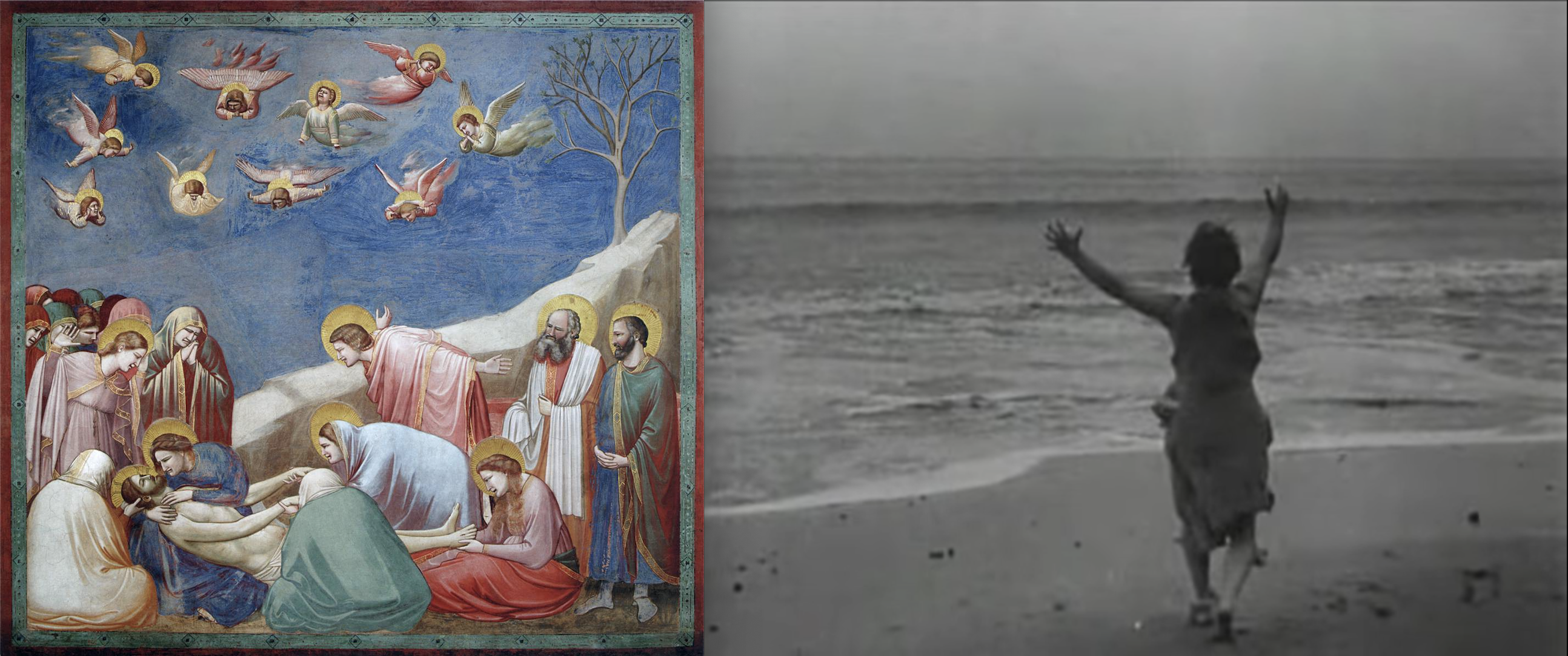
Settings, locales, and backgrounds were a palimpsest upon which Griffith could compound the meaning of acts through time. The lonely wives in Enoch Arden, The Unchanging Sea, and Lines of White on a Sullen Sea all wait in the same place, looking at the same sea, in shot after shot. The films move quickly, as is their nature, and they leave impressions. To have recurrent motifs and shots meant treating each shot both as an independent unit and as chain within an ongoing development. Joyce Jesionowski writes; “Associations and concentrated moments arise from the recurrence of a familiar image in an evolving system of relationships between shots. Instead of spinning a film out like a ball of yarn, Griffith folds it back on itself, creating layers of associations that collect mainly in repeated images, which are often highly condensed portraits. Two effects ensue. The first is that it is impossible to consider a Biograph film as a linear project proceeding simply from beginning to end. The model of a Griffith Biograph film is rather a web of constantly developing relationships, implications that are constantly clarified by reference to recurrent, and therefore increasingly familiar, images.” Griffith creates a self-reflexive world within his films wherein meaning can be determined by the conditions set for themselves, by the language they’ve created. He understood cinemas capacity for unification, for a schizophrenic dispersal throughout time and space. The technique was a realization and utilization of the alienation of time in industrial society. To know these stories which moved so wildly throughout space could be brought together by the viewer is to know how they experienced time; suspended and disconnected, regulated by machines. He understood, too, that the centrality of a single figure’s experience of the world had been usurped by a plurality of multi-faceted, ongoing dynamisms. He could pit differing forms of awareness against one another because the viewer experienced the world as something outside of him, as an orchestrated totality independent of his participation in it, something like a sequence he was looking in on. Thus the films are making an appeal to the ongoing development of social consciousness and the perceptive capacities of its audience, keeping pace with its intensification. The centrality of the figure in Giotto’s work, the distinction between bodies and isolation within space, is met in Griffith’s work with its opposite; an absolute dispersal. The films prick us precisely because of this dispersal, precisely though the manifold consciousnesses, temporalities, and spatial dislocations. Narrative is organized here according to an industrial logic we are helpless in the face of. There are sweet and profoundly human moments represented, however, within this world. There are moments of remembrance amidst the ongoing estrangement, of a vague familiarity when Enoch comes back to his hometown or the character from The Unchanging Sea regains his memory. Joyce describes this process; “One cannot help but be dragged into the ruse that one is thinking and remembering along with the silent characters of the film, making associations as they make them.” Here the machine of cinema makes manifest an image of our inner life.
Usury and the Future
Griffith’s The Usurer tells us another story about entombment; a greedy banker forecloses every unpaid loan owed to him, leading to the sickness, death, and suicide of a few characters. The thuggish henchmen who carry out the repossessions are something like the inverse of Giotto’s angels carrying out messages from the world beyond. They take worlds apart. A helpless woman comes to beg the usurer for her sewing kit back, only to accidentally (and unknowingly) seal him up in his vault where he runs out of air and suffocates. Usury is also at the heart of the Scrovegni chapel in Padua. Enrico Scrovegni commissioned it to secure his place in heaven; he’s seen in the fresco depicting the final judgement giving the church to Jesus. Scrovegni’s father had been placed in a layer of hell in Dante’s Inferno. Usury was considered an illegitimate way of making money because there was no work involved. It circumvented the labor and toil we’ve been condemned on earth to endure. The usurers are the last sinners in the circle of violence. Dante was living in Padua at the time Giotto was painting the chapel. It’s a fond story to think of them spending time together as he worked. The precipices Giotto shows Joachim kneeling on the edge of were the images I had in while reading Purgatoria, while reading in that winding poem of Dante and Virgil climbing up the terraces out of purgatory. Dante started writing his poem a few years after Giotto’s completion of the Scrovegni chapel; were the mental images he wrote also influenced by Giotto’s cliffs?


Dante, Giotto, Griffith, all of them storytellers. The lyric had long since been an established form of story-telling. Without hindsight there is something absurd about how seriously Giotto and Griffith took their crafts, about how much potential they intuited from such unassuming means. The humility and economy of Giotto’s practice are wonderfully described by Ruskin; “Giotto, like all the great painters of the period, was merely a travelling decorator of walls, at so much a day; having at Florence a bottega, or workshop, for the production and sale of small tempera pictures. There were no such things as «studios» in those days. An artist’s «studies» were over by the time he was eighteen; after that he was a lavoratore, «labourer,» a man who knew his business, and produced certain works of known value for a known price; being troubled with no philosophical abstractions, shutting himself up in no wise for the reception of inspirations; receiving, indeed, a good many, as a matter of course,—just as he received the sunbeams which came in at his window, the light which he worked by;—in either case, without mouthing about it, or much concerning himself as to the nature of it. Not troubled by critics either; satisfied that his work was well done, and that people would find it out to be well done; but not vain of it, nor more profoundly vexed at its being found fault with, than a good saddler would be by some one’s saying his last saddle was uneasy in the seat. Not, on the whole, much molested by critics, but generally understood by the men of sense, his neighbors and friends, and permitted to have his own way with the walls he had to paint, as being, on the whole, an authority about walls; receiving at the same time a good deal of daily encouragement and comfort in the simple admiration of the populace, and in the general sense of having done good, and painted what no man could look upon without being the better for it.” Decorating walls like a saddle maker, and not seeing as great a difference between these acts as we do. There was faith, an absolute faith in his activities and the possibility of their becoming great, long before painting had anything to do with greatness. A love of appearances that sought no reward in this world beyond the satisfaction of having dutifully admired them. In thinking about Giotto I feel myself like Kierkegaard wondering at the paradox of Abraham’s faith; I can’t imagine the faith Giotto had, I can’t imagine the nothing that came before it. And the same is true of Griffith, in however bastardized a medium he was working through, and his commitment to the poetry of a language that he knew wouldn’t last long. “Movies,” Griffith commented slowly, “are written in sand. Applauded today, forgotten tomorrow. Last week the names on the signs were different. Next week they will be changed again.”
The few of their works that have narrowly avoided destruction shower down on us like some cosmic coincidence. It’s unlikely that of these artists thought their works would last so long and would puzzle so many. It was Schelling who best understood how Giotto’s work tasks us; “Why do we still regard these works of the masters, from Giotto to the teacher of Raphael, with a kind of reverence and even a certain predilection, than because the fidelity of their endeavor and the great seriousness of their calm, voluntary restrictedness compel our respect and admiration? The present generation bears the same relation to them as they do to the ancients. No living tradition, no bond of organic continuous cultural growth links their age to ours: to become their equals we must recreate art along their path, but with our own energy.”
Somewhere deeply repressed in us is the vague memory that our world was supposed to be the preparation for another one. We’ve made a home of this bivouac for so long that we’ve naturalized its impermanence. These works cull the sense of its temporality; this is their estrangement. We’re reminded that we are at the threshold of the possible still, a horizon yet to be traversed, and they incite us to go further, to give expression to the questions laying dormant within us that we can’t bare to approach but feel only with a vague shudder. We’re driven foreword not by the questions they asked but the faith and certitude of meaningful work done well pointing beyond itself. If we shutter at the estrangement of their works its because of the unrealized potential felt but trapped, as though inaccessible to us; we are not foreign to their characters but to ourselves. Thus, we follow these guides to the horizon of past potential only to embark a journey beyond it, out and down into the “interior of time, to encounter there rhythms from which the sick shall draw strength.” Knights of faith, the ones who show us how to begin.

Bibliography:
“D. W. Griffith: Interviews (Conversations with Filmmakers Series)” (Edited by Anthony Slide) University Press of Mississippi: Oxford. 2012.
Battisti, Eugiono. «Giotto: Biographical and Critical Study.» Skira: Milan. 1960.
Benjamin, Walter. «Illuminations: Essays and Reflections.» (Translated by Harry Zohn) Schocken: New York City. 1969.
Benjamin, Walter. «Selected Writings, 1: 1913–1926.» (Translated by Michael W. Jennings) Harvard University Press: Cambridge. 2004.
Bonnefoy, Yves. «The Lure and the Truth of Painting: Selected Essays on Art.» (Translated by Richard Stamelman) University of Chicago Press: Chicago. 1995.
Clark, T.J. «Heaven on Earth: Painting and the Life to Come.» Thames & Hudson: London. 2018.
Fry, Roger. «A Roger Fry Reader.» University of Chicago Press: Chicago. 1996.
Hegel, Georg Wilhelm Freidrich. «Introductory Lectures on Aesthetics.» (Translated by Bernard Bosanquet) Penguin Books: New York City. 1993.
Jesionowski, Joyce: «Thinking in Pictures: Dramatic Structure in D. W. Griffith’s Biograph Films.» University of California Press: Berkley. 1989.
Merleau-Ponty, Maurice. “Sense and Non-Sense.” (Translated by Hubert Dreyfus and Patricia Dreyfus). Northwestern University Press: Evanston. 1992
Panofsky, Erwin. «Perspective as Symbolic Form.» (Translated by Christopher S. Wood) Zone Books: Princeton. 1991.
Proust, Marcel. «In Search of Lost Time.» (Translated by D.J. Enright) Random House Publishing Group: New York City. 2012.
Ruskin, John. «Mornings in Florence.» W.B. Conkey: Chicago. 1880.
Ruskin, John. «Giotto and His Works in Padua.» David Zwirner Books: New York City. 2018.
Schelling, Friedrich Wilhelm Joseph von. «The Philosophy of Art.» (Translated by Douglas W. Scott) Minnesota University Press: Minneapolis. 1989.
Vassari, Giorgio. «The Lives of the Artists.» (Translated by Julia Conway Bondanella and Peter Bondanella). Oxford University Press: Oxford. 2008.