

The pictorial strategies developed in the Trecento are most generally appreciated for their innovations in the representation of geometric space. Unlike flat byzantine mosaics, Trecento pictures started to become a plane, space began to recede outwards. Paintings were becoming something like a window through which the beholder witnessed the depth of his world expanding out, drawing him in. Panofsky writes that this was “an objectification of the subjective [experience].” And yet, at the time Cimabue, Giotto, and Gaddi were experimenting, the emphasis of a painting wasn’t on the representation of a frozen moment in time. This pictorial demand came later. In the Trecento pictures worked in the service of narrative, what Alberti called the Istoria. And for this reason they’re very economical; everything has to move quickly, to imply the before and after. They use quotations and summarize as much as possible. It strikes us how multiple events can happen simultaneously in these panels. People can appear twice, performing different acts in different places, and this isn’t a contradiction.

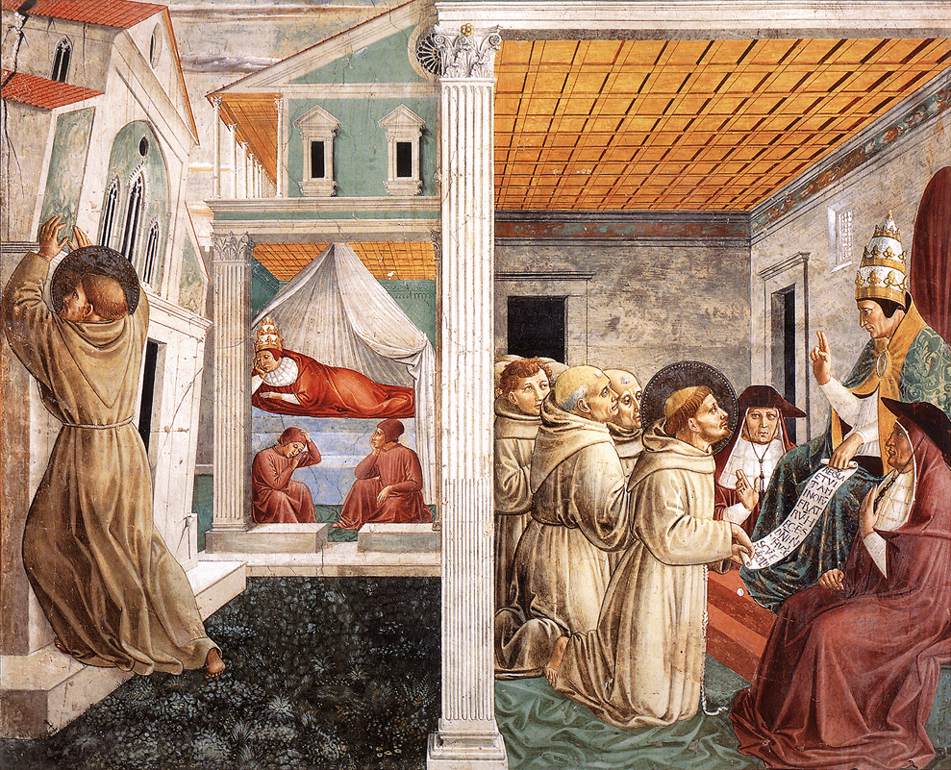
A few frescos and predella-panels by Giotto, Gozzoli, and Fra Angelico depict a story called «The Dream of Pope Innocent III.» They were all commissioned by Franciscan orders to visually imagine the community’s most important foundational story. Pope Innocent III had initially denied St. Francis’s request to form an order of monks. The church was then in crisis, and Innocent III was trying to hold it together by maintaining a central papal authority. A legend claimed the Pope dreamt later that night of the Lateran Basilica falling, and of St. Francis propping it up. It was then that he changed his mind. Le Monnier recounts; « ‹Truly,› cried the Pontiff, ‹this is indeed the man who has been called to sustain and to repair the Church of God.› »

These works show the pope sleeping, dreaming. His dream is conveniently always shown right next to him, in the very same panel. These artists weren’t forced to create a panel for the dreamer and another for the dream. In Giotto’s fresco in Assisi the Basilica is about to fall on Pope Innocent III, though it doesn’t seem to have any weight. Most other renditions of the scene show the church cracking somewhere, but this basilica is completely in tact. Even its foundation tilts, or is raised above the ground level by Francis’s confident right arm. There is something unbelievable about the threat. It looks less like Francis is supporting the church than he is lifting it off the ground with one hand, as if it were a nearly life-size model made of foamcore. And note the entrance; it’s too small for Francis to enter. To give Giotto a bit of license, though, we all know how malleable space can become in our dreams.

A portico’s pillar splinters in the predella to his “St. Francis Receiving the Stigmata.” The church seems to fall as much in the direction of the viewer as it does onto the pope. Here Francis does not seem so confident, using both hands and an outstretched leg to brace it. Our eyes don’t only read left to right, as in the fresco, but from foreground to background (note the receding line of pillars inside the church). There’s a black void where it’s foundation should be. As in his fresco, the floor is tilted at the same angle as the rest of the church. But there’s no ambiguity, here, as to whether or not St. Francis is lifting the church. He’s most certainly breaking under it, about to snap like the pillar. He was not a super-human miracle-worker but a humble saint. When asked by Brother Messeo why the brothers should follow Francis he responded; «Wouldst thou know why all men come after me? Know that it is because the Lord, who is in heaven, who sees the evil and the good in all places – because, I say, his holy eyes have found among men no one more wicked, more imperfect, or a greater sinner than I am; and to accomplish the wonderful work which he intends to do, he has found no creature more vile than I am on earth; for which reason he has chosen me, to confound all strength, beauty, greatness, noble birth, and all the science of the world, that men may learn that every virtue and every good gift cometh from him, and not from any creature, that none may glory before him; but if any one glory, let him glory in the Lord, to whom belongeth all glory in eternity.» This predella always appears first in the series, it is both the cornerstone of the order’s identity and the architectural cornerstone upon which the entire panel rests. St. Francis holds the Basilica in place in the Pope’s dream as this composition holds the panel in place. To witness this act is not to behold an imagination of the miraculous, like the great mysterium of theology in Angelico’s Annunciations, but rather it demands its viewer conjure in faith the fortitude to not bow under the pressure of the world.

Angelico’s versions, made a century and a half after Giotto’s, are more nightmarish, the predella to the «Coronation of the Virgin» in particular. It was an early work. (The other two versions Angelico made follow Gozzoli’s composition, which more strictly demarcate the space between the dream and the dreamer.) In this first predella the open view from the Pope’s bed turns the drama of Francis’s brace into a theater. The flowers of the meadow which have been so carefully rendered will get smashed if Francis grows tired (Pope Innocent will remain outside the path of destruction, though). Angelico elongated the distances between things in a creepy, expansive way. This is intensified by the details of the pink Basilica. Just look at its molding, the flutes of the engaged columns and their faint ornamentation. They’re going to imprint themselves into the soft meadow if he falters. And there is yet another grouping of flowers we can see to the left of Pope Innocent III’s chamber, and just beyond them there is a slim view of an entry way, maybe its a passage to the tall cylindrical tower in the distance. Why all of these details in such a small predella, why so many places for the eye to run away to? Amidst these distractions, St. Francis maintains his focus. The threat of an architectural catastrophe is held confidently in all these images; their economy is so well suited against the threat of disintegration. They don’t make a spatial appeal to us the way Masaccio will, who becomes a victim to the precision of his schemata, a delicacy always on the verge of being shattered. No, these pictures of St. Francis are allowed to set their own rules. They express a confidence in their logic, a certainty that the myth of Francis of St. Francis holding up the Laterna Basilica in Pope Innocent III’s dream will endure the tests of time.

While looking at all these early renaissance paintings John Ford kept coming to my mind. «When the legend becomes fact, print the legend.» Ford’s films often tell two stories at the same time; they create a myth and break it apart simultaneously. They don’t ‹deconstruct› myths so much as they provide insights on the ways we create them, the ways we depend on them. Like Giotto and Angelico, Ford shows us the dreamer and the dream in a single work.
How Green Was My Valley? is an exemplary case; the main character Huw narrates his childhood in a mining town on the coast of Wales with a nearly pathological idealism. Like his family and his fellow townspeople he cannot adapt to change. This ineptitude ultimately tears his family apart, destroys the church, forces his brothers run away to America, and climaxes with his fathers death inside the mine. And in the face of all this Huw maintains a myopic fantasy. The film begins as the mine has dried up and Huw is literally forced to leave his hometown of barren economic necessity. Nonetheless his narration begins; “I am leaving behind me fifty years of memory. Memory… Who shall say what is real and what is not? Can I believe my friends all gone when their voices are a glory in my ears? No. And I will stand to say no and no again, for they remain a living truth within my mind. There is no fence nor hedge around time that is gone. You can go back and have what you like of it… So I can close my eyes on my valley as it was.”

Lesser interpreters have condemned this film as Ford’s idealization of proletariat life, painting a pretty picture of industrial misery, saying that life is all a matter of the attitude you take towards it. Nearly the entire film is in a first-person narration (Tag Gallagher notes that only Max Ophüls Letters to an Unknown Woman employs this radical narratorial format), and perhaps this is why so many viewers have mistakenly viewed this film as pessimistic naivety. This is because they identify Ford’s vision of the world with Huw’s. But Gallagher shows how clearly Ford isn’t identifying with, nor subjecting his audience to an identification with, Huw’s idealism. Rather, the film looks over his shoulder. We see Huw’s attempt to idealize his life in a critical relief to the brutal events transpiring. Huw witnesses his father die in the mine, and yet a few scenes later the father is walking with him through the valley, greeted by his brothers who left for work in America long ago. We empathize with Huw’s ideation but are not absorbed by it. The subjective is objectified. We see the dreamer dreaming and we see his dream.

How Green Was Huw’s Valley? It might have been quite green, but it has long since been buried beneath layers of soot. Ford’s genius is his ability to show the grass and the soot. And like these pictures of St. Francis and Pope Innocent III dreaming, in Ford’s films duality isn’t a contradiction, it is their realism.