

Oftentimes it is assumed that youthful playfulness is lost in transition
lost in translation
as we maneuver from one age category to another
being disciplined to play, in certain spaces and within certain time slots,
what does it mean to play [in high school] – what does it mean to play [on a film set]
Definitions too reductive. Yet they all apply.
During last week, I went to the Open Studios at the Jan van Eyck Academie, and I was lucky enough to see a good film about the important subject of kids and how we force them to play.
Flicker like Flames [sketches towards a speculative film] is a film by the British artist Sol Archer, who, during his period in Rotterdam, tried to make a film with kids from a local high school. They recorded everything themselves. Here’s to the Future is a film by the American filmer and writer Gina Telaroli. A film made with and by friends on a sunny Sunday.
The group of children don’t know cinema. Most of them will become craftsmen. Or might become drug dealers. But before that, they are still permitted to reenact masculine standards by means of remaking scenes from Game of Thrones or Furious 7. Now, they do this together and they have fun in doing so. You see them laughing, making jokes. Working as a team, as classmates, in order to reach their ‘’goals.’’ They play, that is sure. But are they, in their context, capable of playing freely?
 Flicker like Flames [sketches towards a speculative film] (Sol Archer, 2017)
For Telaroli’s film, she invited all sorts of friends to participate in its production. Artists, critics, all sorts of people. Most of them happen to be ‘’experts’’ on cinema. Yet this film is as ‘’messy’’ as the one made by the high school kids. They try to do everything in order to not reach anything. My mom remarked: ‘’I can’t bear watching this, is this even a film?’’ She took herself to bed.
Does true play demand true work? If our mothers can’t even imagine this, I don’t want to think about all the play/work that’s still lying ahead of us. All the play that still needs to be done. To be dealt with. People always say that ‘’we as adults inevitably need to deal with doing the work and nothing but the work itself’’ but perhaps this is not work but play. What then is this? Do I have any clue of what goes through my body when I think of ‘’play’’?
 Flicker like Flames [sketches towards a speculative film] (Sol Archer, 2017)
As was said by Thomas Henricks’ in his essay The Nature of Play: An Overview:
‘’First published in 1938, Huizinga’s work [Homo Ludens: A Study of the Play-Element in Culture] focuses both on the nature of play and on its changing significance in European societies from the classical period to modern times. The best known element of Homo Ludens is Huizinga’s statement of five defining characteristics of play. First, play is a relatively free or voluntary activity in which people set the terms and timing of their own involvement. Second, play is distinguished from routine affairs by its absence of material consequences. Third, play is separated from other activities by its use of exotic rules, playing spaces, ideas of time, costumes, and equipment. Fourth, play is marked by the way in which it both honors rules and yet encourages transgression and disorder. And fifth, play promotes the banding together of participants in “secret” or otherwise outlandish societies.’’
Here’s to the Future is very true, and for many of us, confrontational. Precisely because it is ticking all the boxes of what is outlined above. To me it transposed the idea that very possibly, we should not try to ‘’re-discover playfulness’’ again. But rather: to invent it for the very first time. We see the film and we feel that we’ve been tricking ourselves. That there is nothing to retrieve. Grounded in the belief that a film set can serve as a secluded place in which we make time to strengthen our bonds. To make friends but particularly to make friendships better by allowing each other to do something with our anxieties, safely. Is this also a form of playing with fire?
Later on, Henricks continues:
‘’Although Huizinga was committed to the idea of playfulness as a spirit or orientation within societies, he also emphasized that those same societies historically have maintained frameworks—sometimes involving carefully protected times and spaces—to encourage playful behaviors. Clearly, such is the case with “games,” which are cultural formats that help people interact in defined ways and ensure the continuity of play across time and space. Sociologist Erving Goffman (1974) called these models for behavior “frames.” In that sense, play (as opposed to work, religious ritual, “real” fights, etc.) is a broad cultural arena where people learn to recognize, anticipate, and orient themselves. And there are more specific kinds of play—jokes, daydreams, contests—that we also understand. We “play” when we participate in these cultural forms.’’
Thus I noticed that one group of filmmakers (the high school kids from Rotterdam) is functioning much more within a frame that is supposedly determined to ‘’teach them something.’’ Whereas the second (the film enthusiasts) are much more willing to ‘’learn something’’, collectively. In spite of not needing to be on Telaroli’s set, while all the kids do need to partake in Archer’s shoot. So who’s really, radically, playing?
‘’As the last paragraph of Homo Ludens somewhat ruefully puts it, play in the final analysis “lies outside morals” and “in itself is neither good nor bad.” Play pursues neither truth nor justice but is instead a fundamentally aesthetic endeavor, a set of practices that explore the meanings of experience in a wide range of scenes and settings.’’
And this was precisely what interested me about these two films. Archer exposing education’s necessary evil: cloaked as ‘’play,’’ young adolescents are slowly being taught to indeed judge and to indeed, learn how to act in a shallow resemblance of society. It is important that many of the ‘’frames’’ or ‘’games’’ that are established and played also expand beyond the schoolyard. Telaroli, on the other hand, gets rid of these important restrictions and makes thinkable and sensible a first exposure to play in adulthood, perhaps also in life as a whole. Or is it safe to say: ‘’fun’’?
Both of these films, at points, provide hints of having fun. Now, it’s about time to inject a third player: Helen Hill’s The World’s Smallest Fair (1995). Not only is this unexpected visitor crushing many of the relations that were set and developed by the other two films, but foremost she is no longer concerned with rationality. As Soderbergh wrote when he posted his cut of 2001: A Space Odyssey; The Return of W. De Rijk: ‘’sometimes you have to cross the line to know where the line is. just ask any two-year-old.’’
In Hill’s film, she and her classmates from CalArts ‘’create one square mile of cotton candy in fantastical shapes.» And in this square mile, sounds are recorded and images are taken which were uttered in a secluded period of time. I did ask: if they are really playing, why then are they looking for these boundaries? Is it not a tool in order te retrieve the sanity required to keep going outside of this particular square? Is it not a merely functional way of appropriating our ideas of ‘’having fun’’? Just as functional as the kids from high school? My conviction is: no. The ‘’just as’’ I employed is risky, since it tries to level these two inherently different endeavors. Limiting both their distinctly alternating affects and effects.
 The World’s Smallest Fair (Helen Hill, 1995)

I do need to add that Hill’s film evokes a similar response among flocks of people: namely, that of the assumption that this is not a film, or cannot be taken seriously as a film, because the characters involved do not seem to be taking it seriously themselves. But who says this is so? To establish a sense of communitas, »the sense of sharing and intimacy that develops among persons who experience liminality as a group», a lot of sacrifices are demanded from each of the individuals who agree to participate. The intensity with which I see the – here it comes – art students interact with each other in this film, must have been quite exhaustive. Now, the fact that their involvement is explicitly mentioned in Hiller’s description of the film, is not making it easier for the skeptics to open up. Anyhow: people who live in glass houses should not throw stones, so I’d better rest my case.
What all these films present, are different conceptions and executions of what we see as play and fun. But to reduce them solely as devices to get something done or to reach a different point, is inescapable. Especially in cinema, where we are almost always existing in relation to how people around us spend their time, it is exceptionally daring to try to break with this habit. We are all possibly lonely, and to move away from ourselves we need to act in accordance to others. What some of these do signify, luckily, is that we do not need, a priori, to determine and calculate their outcomes. And I guess all three films that I tried to discuss in this text make such outcomes, and let’s say it, function, rather unpredictable.
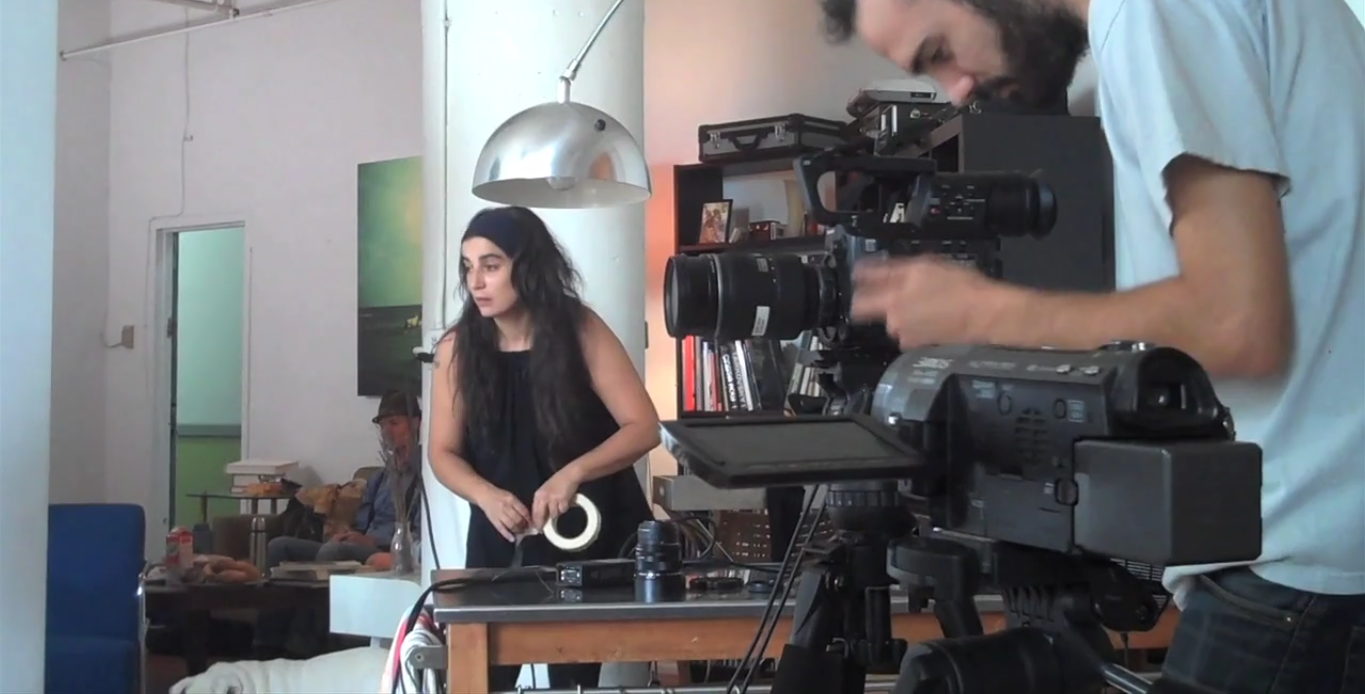 Here’s to the Future (Gina Telaroli, 2014)