
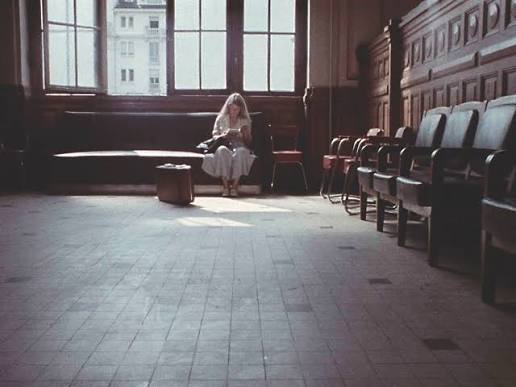
I want to save the world as it fades away. The task is impractical.
(Flora Tristan)
In many reviews of Claudia von Alemann’s feature film debut Die Reise nach Lyon (literally “The Journey to Lyon”, also known as Blindspot), one reads that the protagonist, Elisabeth, who has travelled to Lyon by train, is a historian who no longer wishes to be one, who wishes to be more, who may have to live a different life, and that she has left her husband and child behind in order to follow in the footsteps of the early socialist Flora Tristan, active there in 1844, shortly before her death. None of this is wrong in itself. In the film, however, her family appears just as everything else does: it is no more and no less past and present than any other event, any circumstance that is and that was. The fact that it is nevertheless so often mentioned in the texts says more about those who write about her than about Elisabeth herself.
(The desire to perceive everything at once: the infinity of history, the fleetingness of the present, the finitude of the future. Love, work, obsession, the self, and the way everything dissolves.)
Elisabeth (and with her Hille Sagel’s camera, clear and unreal at one and the same time) observes the city as if through layers that can no longer be unravelled or straightened out. One thinks of the thousands of historical sites one visits in a lifetime, the commemorative plaques on walls, the symbols of what once was, which are carefully maintained whilst what they truly tell us is forgotten. Passive knowledge is Elisabeth’s name for what she is not looking for. She strolls through the city, reads, talks to people. How can knowledge become active? Elisabeth herself is a seeker. Accompanied by slow pans, she enters the city, feeling her way around on foot, recounting that she actually wanted to leave as soon as she arrived.
(The film invites us to rephrase every sentence about it numerous times, to offer different linguistic forms. No image is simply what it shows, precisely because every image is exactly what it shows.)
As with Elisabeth, history unfolds along different paths. There is the (hi)story Elisabeth is searching for, and there is the (hi)story that continues despite her search for Tristan and her traces. Von Alemann confronts the latter in the gaunt-yet-defiant faces of the living – those still alive, those who yesterday were already standing amongst the living – in their narratives and in the city’s walls. For example, the Nazi persecution of Jews in Lyon, supported by the French Milice, shows, as does everything in this film, that it is all about connections, about bridges. This story is also there. It is not absent simply because one does not seek it out. Perhaps that is also why, right at the start, Elisabeth crosses the Masaryk Footbridge, a structure built a decade before Flora Tristan set foot in the city. A bridge that Tristan may well have crossed or at least seen. Perhaps that is why a casual acquaintance tells her of the wear and tear on bridges, of their collapse, of the ravages inflicted by time.
(Footsteps on tarmac are louder than one’s own breathing, the present can never be pushed aside; but, as Elisabeth says, those footsteps can also be the echo of the past as it passes by.)
To see something and to see more in it. This is a definition of cinema and a description of the forces that drive Elisabeth, of someone attempting to forge a connection with Tristan and, through her, with the past, ongoing, feminist, clear-sighted struggle of working women that continues to be legible in the streets. For Alemann, this is not necessarily – or at least not exclusively – about preserving or salving the historical realities relating to Tristan’s work alone; for her and her protagonist, it is also about seeking the forms that this rescue might take, or ought to take. Her interest lies equally in what is (what appears before the camera) and what was. A feeling that otherwise one only gets with Marguerite Duras or in Annik Leroy’s From Dawn to Night – Berlin, as if one were in an in-between world where the camera has learnt to use the past tense.
(A problem, perhaps, in any case: the echoes of women wandering alone in film history – how to break out of this genuine yet also generic loneliness?)
In fact, the entire film is contained within the newspaper clippings collaged together from a single day’s obituaries, which a woman compiles in the cosily gloomy bistro where Elisabeth reads and eats. History as an endless series of faits divers, everything merely a news item, each item a short story as in Félix Féneon’s micro-fictions. How to do justice to this, how to create an image when there are thousands of others that could also be created? Who decides whether an item is newsworthy? How seriously is one death taken and then another? “I learn of several deaths all at once,” says the woman who remains unknown and unrecognised, just like everything here that constantly eludes us the moment it appears.
Why, the film asks, must everything we say and do be understood? Might there not be another form of being, other ways of remembering, in which the lost, the vanishing, the unspoken rise to become the essential? In which the in-between reveals itself precisely in that which is unsettled, that which remains unfulfilled (what, after all, would the fulfilled be?) and opens up new potentials? These potentials that are set free when the voice-over is merely a faint whisper, or when spaces are filmed before they are entered, after they have been left. Potentials that are sensed but not recognised. Potentials of cinema that capture history and the present not on the basis of knowledge, but through meaningful, sensual, ambiguous paths that elude words.
(How else can one know a body in motion that leaves its mark on history?)
It is about that which leaves its impression on the world as an imprint of reality, that which cannot be denied by clever words or systems that have become ossified over the centuries. It is about getting closer to what was; bringing an archive to life, so-to-speak. But it is also about leaving the familiar forms behind, a painful, difficult path lined with external and internal obstacles.
How can things that have already been lived and thought become part of my life? So that one can build upon it, rather than starting afresh time and again? So that not every generation has to fight its battles from scratch? Such questions may seem outdated in the society out of which this text emerges, a society that is increasingly forced to ask itself how it will survive the next day. But they are not. The urgency of every era threatens to make us forget that nothing is achieved by rushing to the loudest, most established, far-reaching channels to announce the upheavals. No, because these channels are already occupied. This also applies to the methods of historical research and historiography. Whosoever uses the same channels and methods will not be able to bring about a radical change but will always arrive at the same conclusions.
(we know this from Gil Scott-Heron, amongst others)
Those who only look ahead will be overtaken from behind.
This is also true of cinema, which, in any case, only knows how to flourish through failure. It fails because it cannot see everything; it always sees only a filtered part of the intangible whole. Blindspot is also a film about the impossibility of memory. Elsewhere, it is termed forgetting. It is a film that, together with its protagonist, resists forgetting.
And then there is that gentle cosiness, unique to cinema, that is found in the foreign and the alienated (a sense of being lost one can and does identify with, amidst empty streets and beautiful bookshops, a brief flicker of desire and the dim light of constant flight); through it, art retains for itself an aesthetic remnant (as if it were an irrefutable triumph over oppression!), in which no one is as beautiful as the most lonely person and nothing seems as inviting as the sense of being lost in a foreign city. But von Alemann may well have discovered in this what Elisabeth is seeking: a different kind of visualisation, of re-presentation, of being between now and then. Cinema has always conjured up ghosts, rarely as unconditionally as here. Blindspot is a film in which the ghost is present from the very outset; the protagonist learns to speak to it, to read its traces, to follow in its footsteps.
(As if one were to open the window and the thicket of the world, woven from all layers of time, were to pour in between thoughts that are trampled to death and feelings that peter out, and for a second all would become light and airy, only for everything to retreat at once back into the shimmering shadow that always falls, because time piles up and piles up until it eventually collapses.)
(Translated by Martin Brady and Helen Hughes)