

Auf dem Filmfestival in Rotterdam hatte Ioana Florescu die Gelegenheit, sich mit dem Filmemacher Ben Russell über dessen Greetings to the Ancestors zu unterhalten. Im Gespräch geht es vor allem um die Arbeitsweise des amerikanischen Künstlers zwischen der Substanz profunder Träume, der Kontrolle über den Stoff, das Suchen und Finden von Kollaborateuren, die Arbeit mit der Kamera und transparente Untertitel.
Ioana Florescu: I want to talk to you mainly about your film Greetings to the Ancestors (which competed in the Tiger Awards short film section and won). It is the third part of your trilogy called The Garden of Earthly Delights. Could you talk a bit about the idea behind this trilogy?
Ben Russell: The title is taken directly from the Hieronymus Bosch painting, which is a three panel painting made a very long time ago. It depicts Eden, heaven and hell and the style rendering is very Christian. It’s not very clear which is heaven and which is hell and where this things exist. So it seemed like a really good framework, like another level to think about these three films together, as all are attempts to produce some kind of earthly paradise or utopia in the contemporary moment. It functions as a loose structure. There is also a Stan Brakhage film called The Garden of Earthly Delights. That is also there a bit but it is not quite as strong an influence. The first film of the trilogy is Let us persevere in what we have resolved before we forget which is shot in Vanuatu and deals with cargo cult mythology but also has a bit of Samuel Beckett within it. And the second film is Atlantis, which is a kind of imagining of what Thomas More’s Utopia would be like if it were happening in the present. In fact, Atlantis deals with what the limits of utopia might be. The third section, Greetings to the Ancestors is a bit more directly spiritual and posits another kind of energy within the space of the film. That energy is maybe Christian, maybe non-Christian but definitely looks towards the invisible world, towards embodiment.
For Greetings to the Ancestors you had as a starting point stories about a substance that causes really profound dreams. How clear a concept did you have when starting to shoot? What is the proportion between working with what you found in that place and following your original plans?
Well, I think that it is pretty difficult to go to a place where you’ve never been with a very firm idea of what is going to transpire. So the structures that I set up beforehand are just guidelines for me to figure out where they might lead me. In the case of Greetings to the Ancestors, I initially had three things that I was after. Only one of them materialized but they all led me to other things. I had heard about this traditional healer who also ran a mortuary. He would wear a suit in the front to greet people and then in the back he would wear traditional clothes. So was he going to be on both sides, in the traditional and the contemporary space. But he didn’t want to be filmed. That was one thread. Another one was the Silene Capensis, which is the root that produces these dreams, that was the thing that that I was searching out. I got in touch with an ethnobotanist in Johannesburg. He put me in touch with this healer which I never ended up meeting but I somehow met this other healer and the other people. So that was still there but I kind of hoped that I would find some Silene Capensis and have some really profound dreams for the time that I was travelling as well. Well, it’s not that easy. So yeah, the short answer is that there are things …they’re just like openings. The research also takes place in this space and it has a lot to do with seeing who is available and interested.
There are many dreams recounted in your film. Which was you criteria for the order in which you arranged them? How did you choose how they would connect to each other and how they should be presented?
I actually didn’t know what anybody was saying until I got back and had it all translated. I was not at all interested in the translation and the interpretation of dreams. I just wanted the people who had a profound experience to speak about that experience in the first person as much in the present tense as it could be. So that is what I asked each of this people to do. The woman who speaks at the beginning didn’t do that. She misunderstood, I think, or it was mistranslated. So she actually talks more about her origin as a single man. It is like a single radical surprise. It was sort of a gift to get that because it actually sets the frame for this other things that happen. I think the remarkable thing about being open to possibilities is that you can be really pleasantly surprised. Things happen, you know. They work out and they work out like…really profoundly.
Can you get back to something you talked about in your masterclass, to the camera? Why did you choose to use hand-held camera? And how does this choice influence the perspective of the film?
In some way it’s really practical just to go with the camera and not bring a tripod and to be able to have your own recording with you and to do everything yourself. If I had wanted or needed to have a tripod or a dolly I would simply have rented one. But it was with the hand-held camera that I envisioned being in this place and moving through there. So I would be the primary presence and the relationships that happens between myself and this people would be initiated and activated through me, through the camera, through this particular kind of agreements. For me the most striking image of the film is the first image of this woman, the first storyteller. I’m 6 foot 2, so I’m pretty tall, and with the camera I need to stand up straight, so I’m even taller and she probably came up to my chest. Which meant that when I was filming her, I was looking down on her. That creates a particular kind of power perspective. I think it is uncomfortable when it first happens in the film. When you first see it and you are not sure what the relationship is. I kept it in the film because when the woman turns and begins to speak or each time she actually turns and looks at the camera, where that power is located shifts. I think it is really important to have those moments take place where a theory is seeded. But for me it’s much more important to have my subjects do the things that they want to do and not the things that I want them to do, or rather to not have them do things. I don’t feel like cinema (or my cinema) is so important that it’s worth offending people or being an asshole. But it totally determines the way that I interact with people.
You said you have the feeling that your camera creates discomfort. What is just as uncomfortable in your film is the use of sound, sound being also the main connection between this world and the world of dreams.
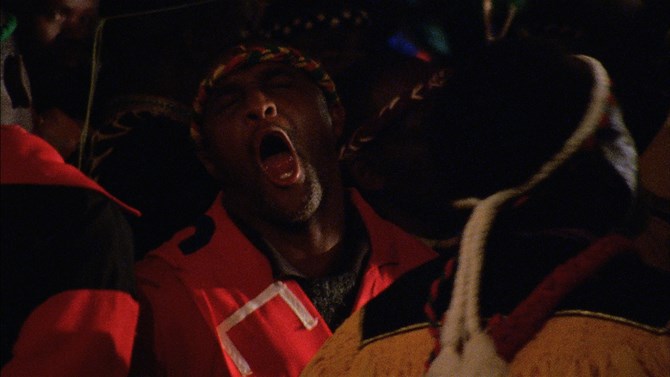
For me sound is at least fifty percent of the film. Often it is more important than the image because the image has so much authority when it presents itself, when you see it, that you do not really question what it is. But through sound the image can get undermined. So creating other sorts of sonic spaces that challange the way that you are able to watch an image is always very important for me. In case of the dreams depicted, in particular, sound moves everything away from this fairy tale space and more into a visceral space, a space that is somewhere between the screen and the audience.
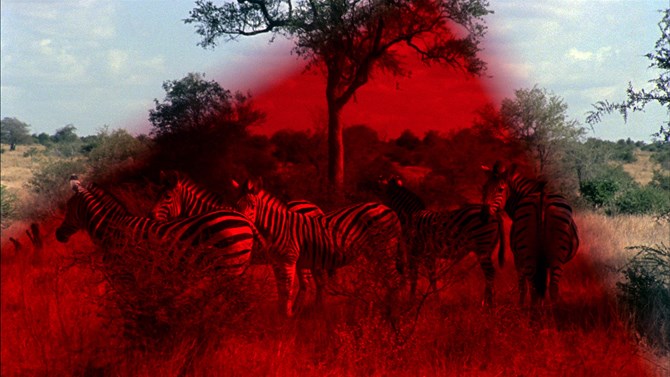
Do the filters you use at times in the film, red plastic actually, also serve this purpose? Are they also meant to create or accentuate that space inbetween?
Yes. They are really clear interruptions. There’s a hand that’s moving in but in spite of our knowledge of what’s happened, that we know that there is a filter being put in front of the lens, the space changes with this red view in front of us. So it is a way of having a direct effect on the space, of allowing that space to oscilate between present, exterior, interior, to create more movement in an image that otherwise would be really fixed.
The subtitles you use look in a certain way. They are almost transparent at some times. It made me think that they are also a motif of this inbetweenness. They look like that in the other films of the trilogy as well and have an unusual function. Why did you decide to make them look like that?
With these three films it was kind of a strategy, it was a formal thing meant to link them together. But in the first two parts of the trilogy, the text is sometimes altered. In Atlantis there is a sequence where some men are singing and the text is not what they are saying but it appears to be it when they are saying it. It’s a mistranslation. It’s credited, at the end it says „subtitles from Thomas More’s Utopia”. So I think there are two intentions regarding the subtitles. Firstly a formal one. Secondly, subtitles are usually presented as evidence, so as an audience we never have any reason to question this. It’s there, it tells us what is being said, so we never think that there is some kind of manipulation happening. But when the text recedes, it becomes part of the image. Then, in the same way that we question what the image is doing, we also ask questions or think about what the text is doing. I feel like I’ve avoided using dialogue and text for a long time in my work, in part because that’s always where knowledge is located and so it supersedes everything else, it has a authority over image, it has authority over sound, it overdeclares what is happening. So for me using subtitles in this manner is a way to resist all that and to allow text to be image, to have you follow it hopefully the same way. So that you are aware that you are looking at it, you are aware that it is information, that it is this thing that is not trying to disappear, it’s there, it’s part of the film.
Greetings to the Ancestors was a commissioned work. How much freedom do you have when doing commissioned work?
I had a lot of freedom. I actually started doing the film before I got the commission. There aren’t many opportunities in the US for art making. There is not much funding available, there are not that many people supporting it. So it’s sort of a relief for Americans to find opportunities outside of the US to make this sort of work. This was an open call for submissions at the Berwick Film and Media Arts Festival. They asked for proposals that were related to a particular theme, they had a deadline and they had a certain amount of money that they would provide. They didn’t have any requirements beyond that, which is good. I made a music video once, though. That’s the furthest I’ve gone in terms of making films for people. It’s better for me to make things the way I think they should be made.
Are you working on a film with Ben Rivers again?
Yes, we probably won’t start shooting until the end of this year or the beginning of next year but it is something that we have been talking about for a while. It takes one of the characters from A spell to ward off the darkness and follows him on this sort of secular, spiritual pilgrimmage. It’s great to work with Ben, he’s like totally hilarious, great storyteller, big weirdo.