

Translation: Éric Volmeer
For the most wild, yet most homely narrative which I am about to pen, I neither expect nor solicit belief. Mad indeed would I be to expect it, in a case where my very senses reject their own evidence. Yet, mad am I not – and very surely do I not dream. But a few days ago there was the most uncanny and yet fascinating incident in the darkness of the Invisible Cinema at the Austrian Filmmuseum. It was dark because those shudders of fear didn‘t approach me through the light of the projector (as they usually do) but through voices and noises from behind me. It was not like Gorky said: „Last night I was in the kingdom of shadows“, but rather the shadow of a kingdom called cinema.

But let‘s keep in a order that makes understanding possible. I went to the place because there was a screening of two films by Gregory J. Markopoulos. Du sang de la volupté et de la mort (Psyche, Lysis, Charmides) and Gammelion. This was one of my first encounters with the cinema of Markopoulos and I can only say how joyful I am that those magic encounters still happen to me. Cinema is a good love that doesn‘t make one grow tired. Cinema has always behind something in the hand we didn‘t expect, something that opens up new possibilites. It is always bigger than we can imagine. The program is curated by Peter Kubelka and runs in his What is Film-cycle. To say one or two words about the combination of those two films: It is just perfect. It‘s a perfect combination. At the same time (as far as I can judge) it transports a perfect introduction into Markopolous as well as it indicates a development within the filmmaker who learned about cinema under the master of sparkle, Josef Von Sternberg. Furthermore it is an argument for film by Kubelka which perfectly illustrates his materialistic view on the medium. The first movement between the two works is one from the dramaturgy of an instant to the heartbeat of a space. Markopoulos asks in his exquisite composed shots and almost fragile rhythms of Du sang de la volupté et de la mort (Psyche, Lysis, Charmides) about the time that is visible only in cinema. The second you close your eyes, the moments we lose without cinema. In Gammelion it is a dramaturgy of space and the second movement becomes visible or invisible very soon. It is from the single shot beauty of the first film to the single frame poetry of the second one. It‘s poetry because those frames seem to vanish the second we first meet them. So this movement only proposes two ways of not “filming an instant“ but rather “making an instant into a film“. It‘s a constant movement of appearence and how to keep it while we forget it, how we forget what we keep. In this regard, naturally, both films deal with time. But it is a special time that was even enhanced by those uncanny happenings in the cinema I will come to in another instant.
Watching those two films next to each other make it very easily possible to discover a film structure that exists beyond representation. There is an organisation of frames in time that can talk about the differences between night and day and that can be full of tenderness. In this regard film becomes the music of light and darkness. So, the third movement of the program lies exactly in the disappearence of sound and acting, the disappearence of images that contain the light of representation. When Gammelion starts we still hear the poetry of Du sang de la volupté et de la mort (Psyche, Lysis, Charmides) and due to that it was very easy to catch the rhythm of the single frames in the second film.
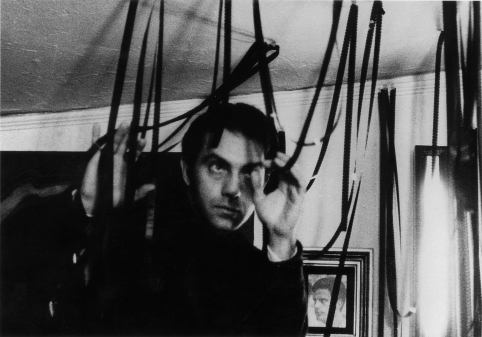
But we were not alone. We were reminded that cinema does not appear in private spaces though it – as Jean Renoir said – speaks to us alone. After about ten minutes of the second film I heard strange noises from behind. First it sounded like somebody was just drinking very often. There was a sense of a wet tongue which penetrated the black screens appearing in front of me. Then breathing got heavier and the wet noises were increasing in volume. Now, I was in the strange situation of not knowing whether someone was dying or having sexual encounters in the cinema. There is a great short film by Roman Polanski called Cinéma Erotique (it was produced as a part of a series of short films set in cinemas called Chacun son cinéma). I glimpsed back and had the impression that there was just one person. I wasn‘t quite sure. For all I knew, the other person could very well be on the ground between the legs or God knows where. Then, music appeared in the film and those noises became less penetrating. Normally, I get very angry when something like this happens during screenings but in this case I was kind of afraid. It was the fear of curiosity but also of possibility. For what would I do if I turned around and witnessed a blowjob while watching Markopoulos? What would I do if someone had an epilleptic seizure?
It somehow occured to me that I might just imagine those things as up to this point I was the only one who seemed to notice them. Maybe behind me were some ghosts of Markopoulos? They come to my back and give a performance of sex and death, tenderness and pain, volupté et la mort…after the music in Gammelion stopped there was another sound. It was the noise of someone scratching accompanied by heavy breathing. Now, I was pretty sure that something sexual was going on behind me and I recognised that I was not the only one in the cinema to hear it. People were turning their heads, I could sense their eyes in the reflection of the projector. But we all tried to ignore it as we wanted to watch the film and still were afraid of what we might discover in the back.

As the scratching and breathing became even heavier I was clearly imagining someone masturbating. I somehow like the idea of someone being sexually aroused while watching Markopoulos though I also fear that those feelings would not come from the film but from a strange (yet quite popular) interpretation of what we can and should do in a cinema. As I slowly got used to the sound something changed in the breathing. It became almost like a gasping for air. After I while I knew what it was: Someone was crying. It was clearly felt pain. Tears were rolling down my back while my eyes were hypnotized by the beauty of time in the film. Was it someone who had lost somebody and searched for help in Markopoulos? Was it someone who wanted to be invisible and discovered that cinema has also lights? Then there was a whispering. It was a lament that seemed to be directed at the screen. I heard that it was a woman and a woman alone. Did she expect an answer by the film? What was she lamenting about? I couldn‘t understand her words but I clearly felt her pain. Was is a psychic fit? I wondered if a call for help would have been the right thing to do. My hands were quite calm and reminded me to watch the film and don‘t let myself be disturbed by those ghosts. Nevertheless I turned around and what I saw is hard to put into words.
It was the pale face of Markopoulos himself. The cinema in the eyes of a time spend, a time stolen, a time changed. But it was‘t real, it wasn‘t of flesh and blood, it was just a projection. A beautiful projection in the darkness. The woman began to whsiper louder. She said: „Please, please, when does it end? Please let it end.“ It clearly was a psychic fit. Someone had to laugh hearing those remarks others were worried. But I could see the danger of cinema: Time. She really was a prisoner of the cinema-situation.
Should I tell her that she can leave any time? There even was someone leaving but she just kept lamenting, almost cursing the screen: „Please let it end. Please, please, please.“ Here crying and breathing almost made her smother. I want to suffocate while watching a film like this. Maybe this woman was living my dream, maybe she was the only one really imprisoned by the film, she‘s lost control. When it ended she disappeared. Nobody saw her real face. The few souls occupying the cinema were looking at each other, some worried, some amused. Everyone found a quick explanation for this woman. Most of them made her a psychopath. Nobody saw her real face. Hereafter, perhaps, some intellect may be found which will reduce my phantasm to the common-place – some intellect more calm, more logical, and far less excitable than my own, which will perceive, in the circumstances I detail with awe, nothing more than an ordinary succession of very natural causes and effects.