
RONNY GÜNL:
„Ein einfacher Zettel, geschrieben in der bekannten Schrift des Leibkalligraphen der Firma Pathé, meldete ganz einfach: ‚Und so setzen tagaus tagein die Islandfischer ihr gefährliches Handwerk fort, unbekümmert um usw.‘ O, ein paar sehr gute Zeilen, die mein Schriftstellerherz höher schlagen machten, denn endlich sehe ich der Sprache, meinem Liebling, den bloßen Worten, offensichtlich den Oberrang über Photographieren und alle modernen Techniken zuerkannt.“ – Max Brod, Kinomatograph in Paris
Es ließe sich denken, für das Schreiben sei im Film kein Platz. Bilder und Töne drängen darauf hin etwas zu vereindeutigen, anstatt beschreibend zu umfassen. Gleichzeitig scheint ein geschriebener Satz unumstößlich, der Film aber beweglich. Den Schreibenden im Kino kommt dabei die Rolle ihrer Person zu und weniger ihrer Tätigkeit. In Le Magnifique von Philippe de Broca ist der Autor François Merlin wie gefangen an seinem Ort des Schreibens, von dem er sich in seinen rauschartigen, zügellosen Fantasien entzieht. Der Film übergeht die Grenzen der eigenen Vorstellungskraft und versetzt ihn in einen Zustand aller Möglichkeiten. Es ist nicht viel von Nöten, sich vorzustellen, dass dies auch einen heimlichen Traum des Filmemachens selbst darstellen könnte.
Dann verkörpert sich das Schreiben aber doch in Form einer Sehnsucht wie etwa in Claude Sautet Les Choses de la vie. Ohne seine Hinwendung für sie zu verstecken, zeigt er Romy Schneiders Rücken sowie ihr umgewendetes Gesicht. Sie erwidert den Blick, der sich in Michel Piccoli personifizierte. Während sie nach den richtigen Worten einer Übersetzung sucht, bleibt der Text, den sie in ihre Schreibmaschine tippt, ungesehen – ungelesen. Für einen Moment erinnert der Film so vielleicht auch an die Texte, die nie geschrieben oder nie veröffentlicht wurden, weil sie sich nur an einem einzelnen Blick festhielten: Was hätte wohl Antoine Doinel aus François Truffauts Les Quatre Cents Coups in seine gestohlene Schreibmaschine getippt?
Womöglich kommt gerade dort, wo sich der Film durch die Schreibenden seine eigene Fiktion begreift, einen Augenblick lang das Wirkliche zum Vorschein. Etwas, das Georg Stefan Troller in seinen zahlreichen Personenbeschreibungen aufsuchte, sei es bei Thomas Brasch, Peter Handke oder Leonard Cohen. Diese Filme sind den Personen zugewandt, aber letztlich dem Schreiben verpflichtet. Jedoch zu zeigen, was das abstrakte Schreiben für das konkrete Leben bedeutet, hat vielleicht nur Georg Brintrup mit seiner Arbeit Ich räume auf über Elsa Lasker-Schüler verstanden. Gisela Stein spielt und zitiert Lasker-Schülers Streitschrift: „Ich räume auf! Meine Anklage gegen meinen Verleger“. Statt zu schreiben, streift sie durch die Straßen Berlins, von dessen Mauern im Hintergrund die Parolen prangen. Schreiben als eine Minimalform, das Unglaubliche zu bewältigen?

IVANA MILOŠ: The trouble with artists depicted in cinema is manifold. To my mind, however, it mostly centers around the portrayal of the unportrayable – trying to lend form to that which evades form, instead swishing around edges, flowing in daunting, meandering directions, careening off the charts, off the map, moving off the known world. This, in a manner of speaking, can be called creation. But I am not sure as to how much of it can be shown, recorded, reproduced – especially not when it comes to an art as abstract and solitary as writing. Still, there are enough examples of biopics focused on artists, or films where the main characters are supposed to be visual artists, where we find ourselves looking away with embarrassment once their “art” is actually shown (it seems as easy enough solution, not showing the artist’s work, but apparently it is hard for film directors to resist the temptation) or the process of making is played out by actors. This is one of many reasons why poet-filmmaker Margaret Tait occupies such a unique position. Her depictions of writing are simple, yet unswervingly nuanced, not shying away from the action itself, but also never crossing the line towards the awkward. She is, after all, a writer herself, and well aware of the pitfalls of creation in words as well as images, seeing as she is a filmmaker too. Her film poems are perfect vessels of plurality, a bringing together of layers, an unearthing of the visible and invisible all at once. In Where I Am Is Here, her stunningly beautiful film poem made up of stanzas/parts/chapters, there are several instances in which the act of writing comes to the fore. Experienced in all their intricacy, these communicate the truest feeling of writing in cinema that I am aware of. The first arrives in the part simply called “Complex,” where a hand is poised at the edge of a page, about to write. The hand is unmoving – all movement is reserved for the camera trying to capture the scene. In the very moment the hand begins to write, the shot ends, shifting to the motion of drops creating rings on the surface of water. Here is the motion beyond all motions, words and images conjoined seamlessly, the invisible shifting into the visible, calling to the viewer as well as the writer, the reader, the dreamer: Here is your world, don’t shy away.
SIMON WIENER:
…through all of this
you’re knowing that I’m here
while you’re there…
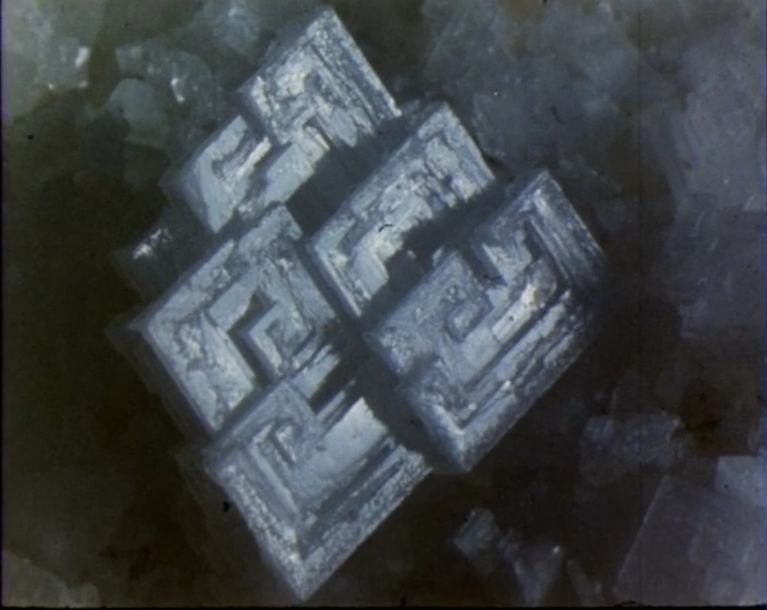
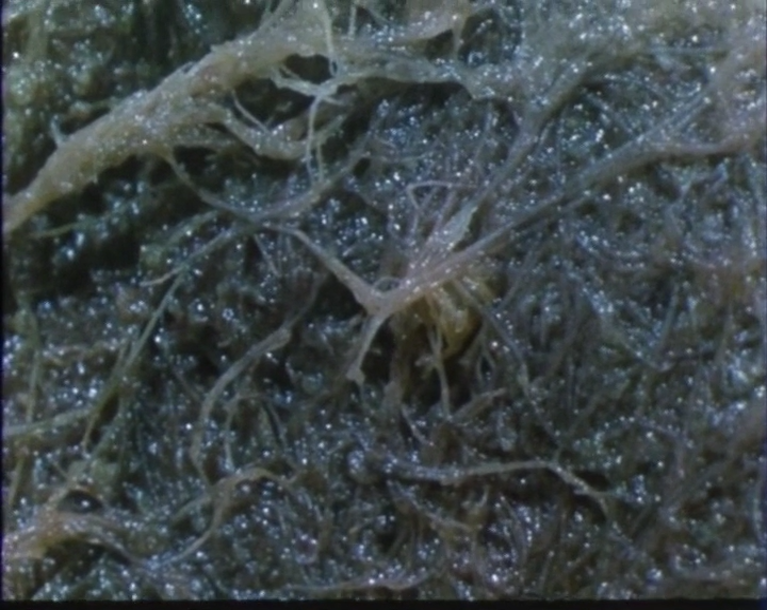
In Joseph Bernards Film for Untitled Viewer wendet sich der Filmemacher direkt an mich, den Zuschauer. Er schreibt mir eine Nachricht, Wörter, Satzfragmente, die auf dem Bildschirm aufflackern. Es gibt nur uns zwei; die Nachricht bahnt sich einen Weg, nicht nur durch Zeit und Raum, sondern auch durch den Film selbst. Wie ein Flussbett trägt der Film die Worte, transportiert und präsentiert sie, hält sie zusammen; zugleich aber setzt er ihnen etwas entgegen; stört sie, die sie Wasser sind, unmittelbar alles zu durchträufeln, in all Erde einzudringen, überall einzusickern.In Kurven, Umwegen, sich zuweilen spaltend, um Binneninseln zu umsäumen, lässt es das Wasser dem Meer entgegenschlingern, hindert es daran, geschwind, geradlinigst dem Meer zuzuströmen. Das Flussbett: einerseits das Film-Material, zwangsläufig mit der Zeit sich abnützend; andererseits ein Arsenal filmsprachlicher Effekte und Eigenheiten, die uns das Gefilmte, oder hier: Geschriebene aufbereiten, die ihm dienen oder es konterkarieren. Die Unterlage formt das Geschriebene, bestimmt dessen Textur und Schärfe. Wie Tinte auf Gestein wirken auf uns die Worte in Bernards Film; zerklüftet durch den Film, durch dessen Flickern, Auf- und Abblenden, Schärfenverschiebungen. Der filmische Rahmen, den gitterartige Strukturen im Bild nochmals echoen, zerschneidet die Worte in Fragmente. through all of this, lesen wir immer wieder. Das Geschriebene behauptet sich, bohrt sich durch all Filmisches hindurch. Die Tinte behauptet sich bei aller Härte und Schroffheit des Gesteins; mäandernd durchfliesst das Wasser die Erde.
SEBASTIAN BOBIK
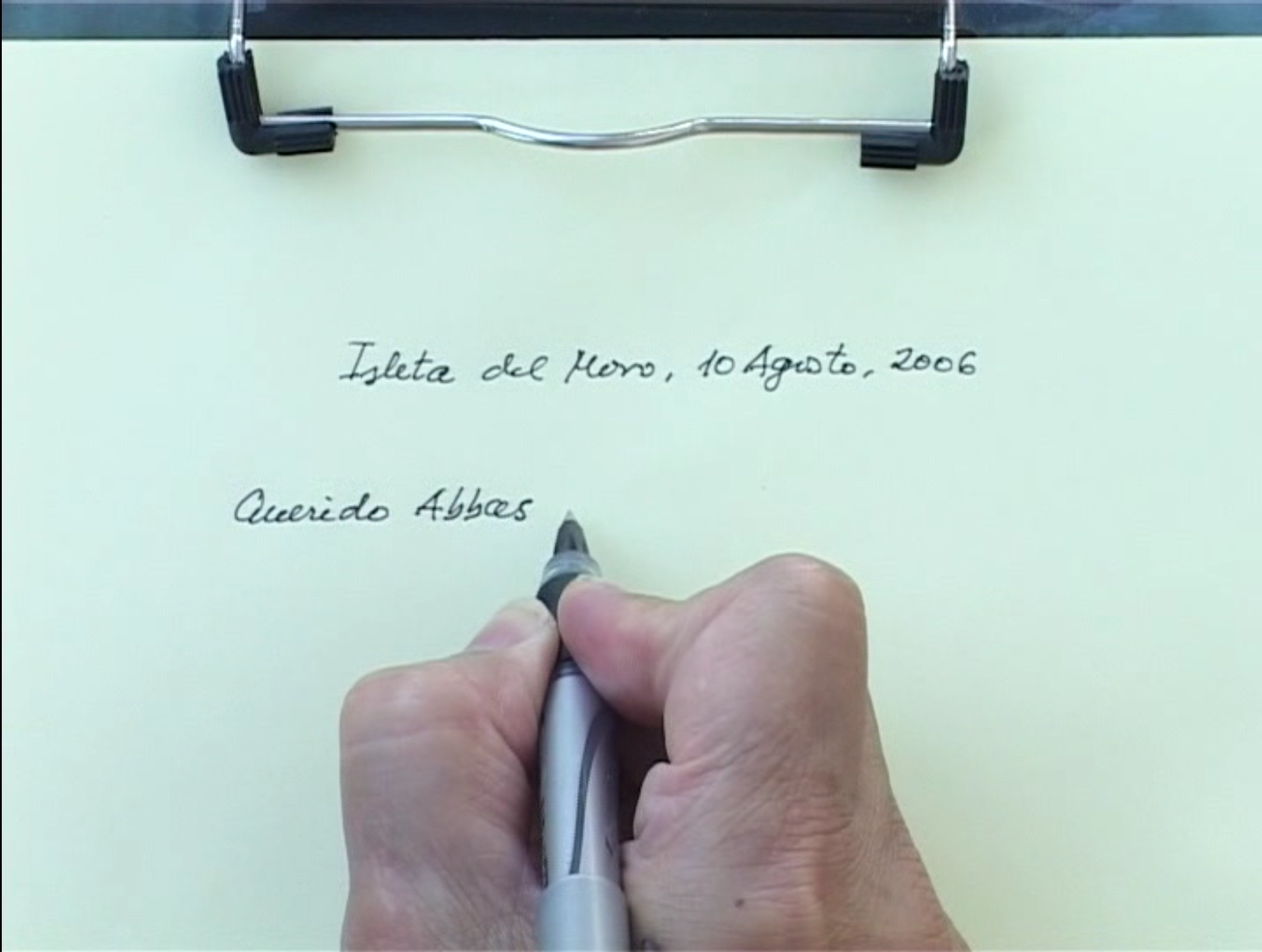
Victor Erice’s Sea Mail is part of a series of short films called “Correspondences”. This series consists of 10 filmic letters, that Abbas Kiarostami & Victor Erice sent each other from April 2005 – May 2007. Over the course of this exchange we see amongst other things: children drawing a tree, a quince streaming down a river until it’s found by a shepherd and a rainy day photographed through several windshields. In Sea Mail however we see only a simple scene. It is the 6th film in the series. Erice sends it to Kiarostami on the 10th of August 2007. In the film we see Erice sitting at the seaside, reading poetry and writing a letter to Kiarostami. The film is only 4 minutes long, yet it seems to tell about the length, care & time it takes to write a letter. It only shows us some steps in this progress: Erice sits at a table reading a book of poetry by a 12th century Persian poet (on the cover of the book he is spelled as Omar Jayyam, though in the English language one seems to mostly finds the spelling Omar Khayyám). In the background we see another book, this one with poems by Forough Farrokhzad. After drinking a glass of water Erice starts writing. We can only make out the opening words of the letter before the film cuts into wider shot again, showing us Erice writing against the backdrop of the sea and a mountain. After finishing the letter he carefully rolls it together and puts the paper into a glass bottle, which is then thrown into the ocean, where the waves will take it to unknown shores.
ANNA BABOS: Sonia in Ernst Lubitsch’ The Merry Widow is a great diarist. Her desires are deep and conflicted, which makes for a meaningful subject to write about. Nevertheless, the typical hardship of isolated writers casts a shadow over her as well. She encloses herself in her bedroom and has no experience of life, she cannot relate her lovesickness to impressions that could be formulated into thoughts. The great object of writing, pain, becomes the obstacle itself. Thus Sonia’s sentences get shorter and shorter, simple, unexpressive, and unnecessary. Then – without any apparent external change –, she gets out of bed, frees herself from the space of self-pity, sits down at the table, and starts to write; in fact she writes as much as a glass of ink, as suggested by Lubitsch’s elegant dissolve. From the synchronized rhythm of her singing and writing, it seems that what she puts on paper is the lyrics of her song. This song contains imagination, speculation, introspection, conditional sentences. What changes is the extent of her unhappiness. Lubitsch asks the question: how can one write about the sentiment if the endurance of it is so tiring and uninspiring. As he answers, he depicts time and the process of Sonia distancing herself enough from the disappointment to be able to write self-reflectively.
JAMES WATERS:

There is a scene in the final part of C.W. Winter’s and Anders Edström’s The Works and Days (of Tayoko Shiojiri in the Shiotani Basin) in which an elderly man describes his process of writing postcards. He emphasises the fact, multiple times, that he writes them by hand at the encouragement of his calligraphy teacher. He began this ritual many years ago, writing to various friends and family members – likely among the 48 people in total among the Shiotani community, up in the mountains of Kyoto prefecture. We’ve seen some of these people earlier in the film, sharing a land that doesn’t seem demarcated by neighbouring sections or designated housing. He describes the process of writing these postcards – when he began many years ago – as somewhat difficult, initially struggling to write more than one a day.
This is of no concern after enough time, however, as he now finds an immense pleasure in picking up a pen and exerting part of his days’ time and effort into these postcards and can write up to ten of them a day (spending one minute on each). Having received an expression of concern, a question or compliment, the recipient has been reminded that someone nearby is thinking of them. Regardless of a response, the writer will have already engaged in the now decades-long ritual of stimulating his mind; asking questions and making observations that – with the years – have become increasingly succinct. The man’s own articulation and clarity of perspective will no longer be so hard to reach.
ANDREW CHRISTOPHER GREEN: It took six years for Rita Azevedo Gomes to secure funding for the production of her first film, O Som da Terra a Tremer. You get the sense watching it that the script was written and unwritten and rewritten many times during those six years. The film is about a writer named Alberto (played by José Mário Branco, though originally intended to be Antonio Orlando, who died just days before shooting began). It begins with him narrating a story he’s writing (the namesake of the film), and one gathers that this narration is Alberto’s inner-monologue, indulging in a stream of thoughts about his life, his personal philosophy, what he sees through his window, and so on. We don’t assume it to be the content of a fictional story he’s writing. The camera’s movement over his shoulder out through the window above his desk seems to further establish our assumption that the voice is dictating the present, but then there is a cut and pictures of the blue ocean flood the screen, and the narrator begins talking about his life in the marshlands, far away from the location we just saw him in. This schism isn’t merely a disjunctive introduction but becomes the core dynamic sustained throughout the film: many layers of stories are compounded on top of and interwoven into one another. One of the plot lines deals with the character in the story Alberto is writing, a sailor, who has a missed encounter with a woman while on leave. This is the sailors backstory, though. We get a glimpse of his life before he is stationed in the marshlands where he’s taken up in Alberto’s story. Alberto’s writing is taking a toll on his life. He’s insecure about it. He tries talking to his friends, who are mildly supportive, but he claims he can’t explain his intentions for writing without them loosing their meaning. He ends up renting a hotel room across the street to see if anyone will come check in on him, and also to get a bit of distance from himself and his process. “I don’t know how to invent, all of this was already written by many others, long ago,” Alberto confesses. He claims to be searching for the unconscious, which he calls the “part of God”, and for it to narrate all this written by many others, long ago. Gomes’s script, too, was already written by others; it’s a loose collage made up of parts of André Gide’s “Paludes” and Nathaniel Hawthorne’s “Wakefield.” There was already a great deal of resistance and fragmentation written into the patchwork script, but Gomes’s direction of it into a film became another opportunity to unwrite it all over again. She places a lot of value in the possibility of a chance encounter between speaking and seeing, between whats been written and whats being shown. There’s the hope, most acutely felt in the overlays and dissolves between scenes, that new associations might be unearthed in this interaction. “I like my epoch, for it is an epoch where everything is missing, and for this very reason maybe it’s the true epoch of fairy tales,” the narrator of her A Colecção Invisível begins the film saying. Similarly, Alberto insists that his character isn’t unhappy despite the loneliness of his situation surrounded by the swamps; he tries to make peace with his situation and wouldn’t trade places with anyone else. I sense Gomes doesn’t resent her situation either; the six years of dreaming and writing in an epoch where everything is missing lead to the creation of a beautiful film that feels like a half-remembered fairy tale, one that writes and unwrites itself on us through iridescent celluloid.
DAVID PERRIN: Denke ich an die ersten Bilder meiner Kindheit, fällt mir jenes von Jack Nicholson aus dem Film The Shining ein, auf dem er an einem riesengroßen Tisch sitzt und auf einer Schreibmaschine wieder und wieder den selben Satz herunterhämmert: All work and no play makes Jack a dull boy. Das Geräusch der Schreibmaschine, ein stetiges Rattern, das gespenstisch durch die leeren Räume des Overlook Hotels hallt.
Die Schreibmaschine des Großvaters hatte ich auf dem Teppichboden des Wohnzimmers vor dem Fernseher gestellt, auf dessen Bildschirm Jack Nicholson seinen Satz endlos weitertippte, während ich als achtjähriges Kind versuchte, den Schauspieler nachzuahmen; ein ungeschicktes Stottern und Stolpern, ohne jene schöne Regelmäßigkeit der Bewegung im Film. Die kleinen Finger verpassen die Buchstaben, die Typenhebel der Tasten klemmen zusammen, die Wörter auf dem Papier bilden ein sinnloses Wirrwarr.
Jahre später: Der Großvater längst verstorben und die Schreibmaschine liegt verstaubt als Erbstück in einer vergessenen Ecke der Wohnung. Inzwischen wurde das Filmschauen auch zu einer Art Schreiben. Doch ab und zu lasse ich die Finger über die Tasten streifen, deren Buchstaben mit der Zeit verblichen sind, und erzeuge damit eine Musik, die durch die überfüllten Räume meiner Erinnerung ihren Nachhall findet.
PATRICK HOLZAPFEL: Ich war einmal im Kino mit einer Frau, die mich an Marguerite Duras erinnerte. Sie sprach schnell und langsam zugleich. Es war, als wollte sie vergessen, aber mir mitteilen, was sie vergisst. Kaum hatten wir uns gesetzt, es war irgendein belangloser Film über die Liebe, wurde der Saal abgedunkelt. Ich sah, wie ihre blasse Hand in ihrer goldenen Handtasche nestelte, um ein schönes altes Notizbuch mit ledernem Einband hervorzuholen. Es war, als leuchteten ihre Bewegungen in der Dunkelheit, ihre Hand, ihre Tasche, das Büchlein. Der Film begann und mit ihm das Schreiben. Diese Frau schrieb beinahe ohne Unterbrechung während des gesamten Films in ihr Notizbuch. Manchmal blickte sie auf, zum Beispiel, als auf der Leinwand geschluchzt wurde, so als wollte sie sehen, wer da weinte und dann schrieb sie weiter. Noch während des Abspanns ließ sie das Buch zurück in ihre goldene Handtasche gleiten. Sobald das grelle, ernüchternde Licht angestellt wurde, schenkte sie mir einen müde lächelnden Blick, als wäre nichts gewesen, als wäre nichts geschehen, als hätte sie nicht eben in ihr schönes Notizbuch geschrieben. Wir spazierten etwas in der angebrochenen Nacht, aber ich traute mich nicht, sie nach dem zu fragen, was sie geschrieben hatte. Erst als wir nach einiger Zeit in einer Bar saßen und sie sich kurz entschuldigte, wagte ich, in ihre goldene Handtasche zu greifen, um das Notizbuch mit dem ledernen Einband hervorzuholen. Ich schlug es auf. Als sie zurückkam, weinte ich. Das Notizbuch hatte ich zurück in der goldenen Handtasche verstaut. Sie sah mich verdutzt an. Warum ich weinen würde, fragte sie mich. Weil der Film so schön gewesen wäre, entgegnete ich.