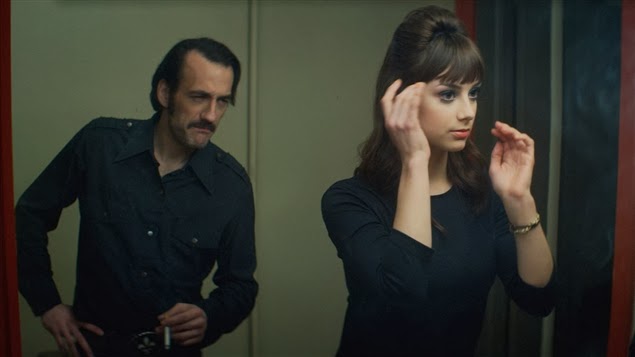
Cinema is sexy. Cinema was sexy. “Hunting the Northern Godard” by Éric Morin is a piece of nostalgic revolution, a search, not for the eponymous famous director, but for the kind of cinema he stood for: Revolutionary and sexy! (At least in the beginning…) Morin, a Canadian music video director makes his first feature film a colorful homage to the early hipster films of the Nouvelle Vague without ever achieving their deepness, richness and diversity. It almost seems like he has watched more screenshots of Anna Karina in “Pierrot Le Fou” than actual movies. In the end his debut feature offers light entertainment with some charming moments and nothing more.
The film is about the people of Abitibi, a remote little town in Northern Canada. Based on true events the French, by then rising firmament of world cinema, Jean-Luc Godard arrived in the snowy city to exercise a television revolution. He wanted to give voice to the people, the workers and housewives and the broadcasting station gave him a carte-blanche. The movie shows how Godard’s henchmen execute the radical ideas of the famous director, who in the meantime travels the forests to take some photos and sleep with Indian girls. It is also the story of a collapsing relationship and of Marie, a young inhabitant of Abitibi with a strong desire to leave her daily routines. Morin’s Anna Karina is beautiful actress and Canadian shooting star Sophie Desmarais. The camera just falls in love with her big eyes and her movements and sometimes it feels like the director loses his contact with the narrative just to capture beautiful movements of Desmarais. Conveniently, she is told by her wooing co-worker that she should be an actress because of the way she holds her cigarette. There are at least two scenes that show the talent of Morin. The first is when the boyfriend of Marie tells her a story of animals being shot and every time he says “Bang” a loud shooting-sound shocks you accompanied by the image of a falling deer. And the last shot when Marie heads to an uncertain future with the camera just exploring her face and her tears, while she sits in the back of a taxi.

But the script lacks too many things to go unnoticed. The political issues are confusing as well as the character of Godard who is portrayed as a hovering ghost above the project but remains a caricature of his artist personality. He always smokes, rarely talks and is victim of some bad jokes. How political nostalgia could have been portrayed in a more charming and intellectually satisfying way shows, for example Pablo Larraín’s “No”. The problem with “Hunting the Northern Godard” is that it never really knows where it goes: Comedy, drama, history lesson, revolutionary movie, movie concerning revolution, movie concerning television, melodrama, coming of age and gender issues all mix up to an average arthouse chaos.

In the end the rural people of Abitibi dismiss the idea of a democratic television structure. In a metaphorical scene the local workers shoot some helpers of Godard leaving him alive in the snow. Morin offers glimpses of a modernist approach to sexy cinema when he goes further than you would expect him to do. But it is the urge to give his characters reasonable motivations, to stick to a certain tradition of storytelling, which lets Morin’s revolution disappear in the white snow of Canada, too.