


- Excerpt taken from the short story Días de 1978 by Roberto Bolaño, from his collection entitled Llamadas Telefonicas (trans. Chris Andrews)
This might be a good time to leave, thinks B. But instead he opens the bottle and offers them a glass of wine, which the pale girl accepts without without batting an eyelid, as does U, although he seems unwilling or unable to drink and takes only a sip, as if not to offend B. And as they drink, or pretend to drink, the pale girl starts talking, telling them about the last film she saw; it was awful, she says, and then she asks them if they have seen anything good, anything they could recommend. The question is, in fact, rhetorical. By posing it the pale girls is tacitly establishing a hierarchy in which she occupies a position of supremacy. Yet she observes a certain queenly decorum, for the question also implies a disposition (on her part, but also on the part of a higher agency, moved by its own sovereign will) to grant both B and U places in the hierarchy, which is a clear indication of her desire to be inclusive, even in circumstances such as these.
U opens his mouth for the first time and says it’s a long while since he went to the cinema. To B’s surprise, his voice sounds perfectly normal. A well-modulated voice, with a tone that that betrays a certain sadness, a Chilean, bottom-heavy tone, which the pale girl does not find unpleasant, nor would the people shut in the bedroom, were they to hear it. Not even B finds it unpleasant, although for him that tone of voice has strange associations: it conjures up a silent black-and-white film in which, all of a sudden, the characters start shouting incomprehensibly at the top of their voices, while a red line appears in the middle of the screen and begins to widen and spread. This vision, or premonition, perhaps, makes B so nervous that in spite of himself he opens his mouth and says he has seen a film recently and it was a very good film.

And straight away (though what he would really like to do is extract himself from that armchair, and put the room, the house, and that part of town behind him) he begins to tell the story of the film. He speaks to the pale girl, who listens with an expression of disgust and interest on her face (as if disgust and interest were inextricable), but he is really talking to U, or that, at least, is what he believes as rushes through the summary.
The film is scored into his memory. Even today he can remember it in detail. At the time he had just seen it, so his account must have been vivid if not elegant. The film tells the story of a monk who paints icons in medieval Russia. B’s words conjure up feudal lords, Orthodox priests, peasants, burnt churches, envy and ignorance, festivals and a river at night, doubt and time, the certainty of artand the irreparable spilling of blood. Three characters emerge as central, if not in the film itself, in the version of this Russian film recounted by a Chilean in the house of his Chilean friends, sitting opposite a frustrated Chilean suicide, one beautiful spring evening in Barcelona: the first of these painters is a monk and painter, who unintentionally brings about the arrest, by soldiers, of the second character, a satirical poet, a goliard, a medieval beatnik, poor and half-educated, a fool, a sort of Villon wandering the vast steppes of Russia; the third character is a boy, the son of a bell caster, who, after an epidemic, claims to have inherited the secrets of his father’s difficult art. The monk represents the Artist wholly devoted to his art. The wandering poet is a fool, with all the fragility and pain of the world written on his face. The adolescent caster of bells is Rimbaud, in other words the Orphean.
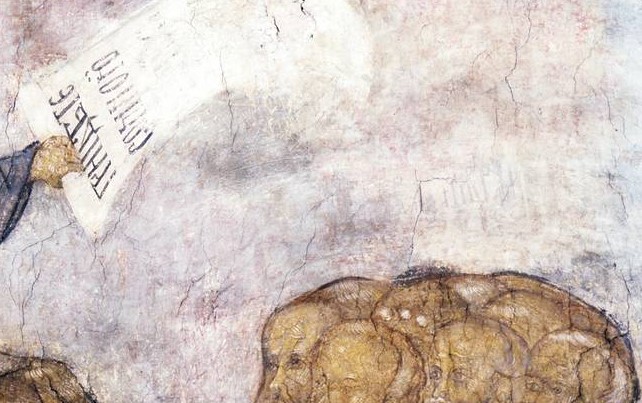
The ending of the film, drawn out like a birth, shows the process of casting the bell. The feudal lord wants a new bell, but a plague has decimated the population and the old caster has died. The lord’s men go looking for him but all they find is a house in ruins and the sole survivor, the caster’s adolescent son. He tries to convince them that he knows how to cast a bell. The lord’s henchmen are dubious at first, but finally take him with them, having warned that he will pay with his life if there is anything wrong with the bell.

From time to time, the monk, who has renounced painting and sworn a vow of silence, walks through the countryside, past the place where workers are building a mould for the bell. Sometimes the boy makes fun of him (as he makes fun of everything). He taunts the monk by asking him questions and laughs at him. Outside the city walls, as the construction of the mould progresses, a kind of festival springs up in the shadow of the scaffolding. One afternoon, as he is walking past with some other monks, the former painter stops to listen to a poet, who turns out to be the beatnik, the one he unwittingly sent to prison many years ago. The poet recognises the monk and confronts him with his past action, tells him, in brutal, childish language, about the hardships he had to bear, how close he came to dying, day after day. Faithful to his vow of silence, the monk does not reply, although by the way he gazes at the poet you can tell he is taking responsibility for it all, including what was not his fault, and asking forgiveness. The people look at the poet and the monk and are completely bewildered, but they ask the poet to go on telling them stories, to leave the monk alone, and make them laugh again. The poet is crying, but when he turns back to his audience he recovers his spirits.


And so the days go by. Sometimes the feudal lord and his nobles visit the makeshift foundry to see how work on the bell is progressing. They do not talk to the boy, but to one of the lord’s henchmen, who serves as an intermediary. The monk keeps walking past, watching the work with growing interest. He doesn’t know himself why he is so interested. Meanwhile, the tradesmen who are working under the boy’s orders are worried about their young master. They make sure he eats. They joke with him. Over the weeks they have become fond of him. And finally the big day arrives. They hoist up the bell. Everyone gathers around the wooden scaffolding from which the bell hangs to hear it ring for the first time. Everyone has come out of the walled city: the feudal lord and his nobles and even a young Italian ambassador, for whom the Russians are barbarians. Everyone is waiting. Lost in the multitude, the monk is waiting too. They ring the bell. The chime is perfect. The bell does not break, nor does the sound die away. Everyone congratulates the feudal lord, including the Italian.
The celebration begins. When they are over, in what had seemed a fairground and is now a wasteland scattered with debris, only two people remain beside the abandoned foundry: the boy and the monk. The boy is sitting on the ground crying his eyes out. The monk is standing beside him, watching. The boy looks at the monk and says that his father, drunken pig that he was, never taught him the art of casting bells and would have taken his secrets to the grave; he taught himself, by watching. And he goes on crying. Then the monk crouches down and, breaking what was to be a lifelong vow of silence, says, Come with me to the monastery. I’ll start painting again and you can make bells for the churches. Don’t cry.

And that is where the film ends.
When B stops talking, U is crying.
