

Please allow me a short remark before starting with my initial reaction to Pastorali by Otar Iosseliani. When I first started writing about film it was all because of a strange impulse that wanted to understand and save the memories of a certain film through writing. It somehow had to be an immediate response as if I was afraid to loose the emotions this or that film educed from me. After writing about cinema for a couple of years this impulse has somehow grown weaker. I think it happened not because my excitement was less or my understanding was better, but just because I experienced the quality, pleasure and reason of slower writing. As we say: To let thoughts grow in itself, to read other stuff about it, to see more, to see again, to find a more precise position. When watching Pastorali yesterday night at the Austrian Film Museum all this reason vanished. I just had to write. Or in other, more commonly used words: It is a film that restored my faith in cinema (though I didn‘t really need it at this time).
Pedro Costa‘s notion that with his films he wants to write letters for those who are too tired to write gets a whole new turn when thinking about Otar Iosseliani‘s stunning Pastorali. The notion of this film could be: The images give music for those that are not able to hear it.
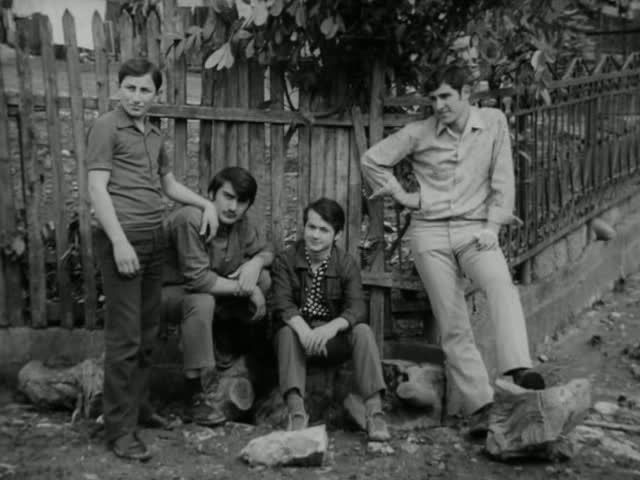
In this film that moves our gaze through the daily struggle and life of a rural village in Georgia, a couple of musicians try to practice their music at a village that doesn‘t really ask for it. Their music disappears and flourishes beneath the sounds of the place. People fighting, screaming, always working, it is a grubby and noisy place full of animals and emotions. Even a peaceful apple tree is screaming with the sound of insects. It is like a dance, it is, in Iosseliani‘s words, like a skeleton that moves and rubs image against image in the most poetic way possible. The musicians are always interrupted when they start, every movement is juxtaposed with another movement and a muddy irony establishes a musical poem with images that remind of Jacques Tati as well as of Lucian Pintilie. The letter Iosseliani writes is not possible. The musicians hardly understand the rural people. Yet, a connection gets established through music or better: “the musical“ as the film moves on. In the end, a girl of the village listens to music after the musicians have left the place. It is a memory but it is also a sound as well as it is part of the heart of the people. Iosseliani‘s artistic education started with music and music shapes his cinema.
We could approach a description of the film by talking about different musical patterns. The first one that comes to mind is: Repetition. In Pastorali images reappear. There is for example a farmer almost collapsing under the sheer mass of the hay he is carrying. We see him two times with the hay. Women are constantly hanging out the laundry or cleaning up. We see them so often that the working women become something like an establishing shot. The musical patterns are also constructed around the ideas of arriving and leaving. Movements get repeated in different directions that way. For example the bus bringing the musicians arrives at the beginning of the film and leaves at the end. This way a feeling of volatility gets established.

Moreover themes or motives get combined after a certain time. For example, lets look at the sun and the window. The sun is (as so often in cinema) mostly present off-screen. But certain shots focus on the distant planet. One announces a kind of eclipse through dark clouds, one is just the peace of a well deserved evening. The window is a more prominent motive in the film. One of the inhabitants builds a new window and causes violent protests by his neighbors who are not happy about the window facing their garden and house. A huge argument develops while the window is set up into the unfinished building. As all good metaphors in cinema this window is a metaphor for too many things to nail it down to one. Later a mediator tries to communicate through the window but there is a distance now that allows silence or privacy. There are much more windows in the film. Constantly people are looking ot of them. Are they in a prison or on a stage? Then it gets evening and the window merges with the sun. In a shot unmatched in its beauty we gaze through the window at the sun. Even if there was no reason to build this window, this shot alone justifies it all. Suddenly the rather absurd work with the window gets a sense. Here we can also find one of the underlying ideas of the music in the images as beneath all this chaos and stumbling lies beauty and necessity. After this shot the filmmaker cuts to the owner of the window smiling confidently, while staring at the sun through the window.
Another musical pattern we might refer to is the rhythm or pace. As the musicians restart their practice from time to time the movement of images and sounds draws a deep breath and starts from the beginning. The feeling of a very organic “Stop and Go“ gets enhanced by the way natural forces are presented in the film. We can think about rain and sunshine here or the way Iosseliani shows the passage from day to night and back again. Seemingly the pace comes from a nature the films observes. It follows the rhythms of the village and every attempt to add something external to the place (starting to play the music) gets swallowed until it is a part of the organic poetry of sounds.
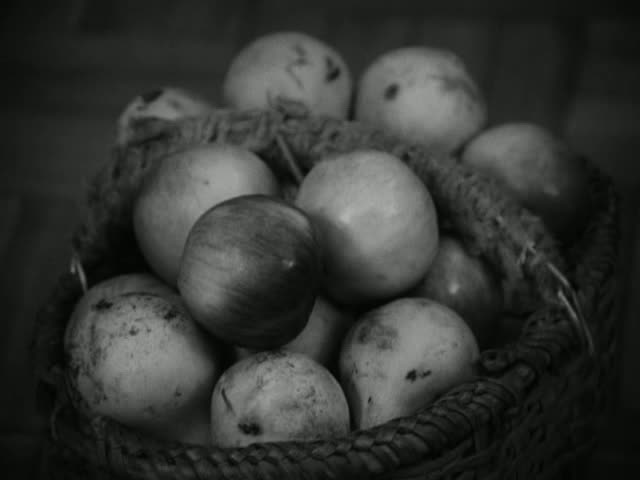
The editing of Pastorali is close to António Reis, Robert Beavers or Artavazd Peleshian. On the one hand we can clearly sense a sort of intellectual pattern that works with political juxtapositions or associations (Eisenstein is the common man of reference here). For example if you can see apples, then you have to see where the tree is standing, too. If you can see the beauty of the horse, you have to see the struggling of the cow. If you can see all those people being transported at the same back of a truck, then you have to see yourself watching them from a passing train. However, there is also something else that can be related to this rather unusual combination of directors cited above. There is a playful, tender element that searches for an image between what we can see, it was named a third image, but with Pastorali I would prefer: A musical image. Peleshian talked about a montage with images that don‘t exist. He talked a lot about the combination of the visual and the aural. With Pastorali the aural is a melody. Peleshian named his montage, a montage of contexts where images are shown in different contexts. Iosseliani plays with this by using irony and poetry at the same time. A good example would be an unforgettable fishing scene in which two “fishermen“ (one wearing a tie, a shirt, very short trousers and gumboots) have a very strange method of getting their fish out of the water. The sequence begins with an explosion without context. Something exploded in the river, a spout of water in the air. We don‘t know what caused the explosion. Our two fishers run to the place of the explosion in the river and collect the dead fish. Now, for the first time in this sequence our perception is shifting but still different possibilities remain as to what might have caused the explosion. After a while we finally see it. One of the guys throws a grenade into the river. As we still have to deal with the absurdity and violence of this procedure we see in what we can call a Georgian-John-Ford-shot a man on a horse arrive from a distance. Now again, we do not know why he is coming and who he is. There is no context, just the idea of arriving. First there is just the sound and the image. The context shifts when he finally arrives and we see that the rider is a guard who cares shit about what his two friends are doing. As the context grows more and more important throughout the scenes it becomes clear that a sole image is not to be listened to without its context. It feels like discovering melodies in a musical composition. We can say that context is also a question of sounds and music in Pastorali. It is as if every element of the soundtrack adds to the musical composition. Iosseliani works with repetitions, juxtapositions and rhythms on the soundtrack, too. For example we can hear singing birds as well as a roaring airplane. Sudden screams as well as tender muttering. Like with Tati a feeling emerges that makes us accept all those sounds as part of the same universe, a universe that goes on without the put-on drama we tend to fall for.
This is to say, of course, Iosseliani‘s montage is not really comparable to the one‘s of Beavers, Reís or Peleshian, it is just a combination of form, music, poetry, politics, tenderness, playfulness and the importance of their theories that brings them to mind. This brings us back to the skeleton where everything works for itself but also as part of a bigger flow. The musical image is also an image of love in Pastorali. There is a love story told through two images rubbing against each other: Secret gazes, little movements, the excitement of arriving and the melancholy of leaving. The story exists but isn‘t told between a young woman of the village and a musician. Like the music, the love is never really allowed to blossom as it blossoms in-between the images. There is a smile, a look through the window, a way to look at the mirror and of course, the movement between two shots that carries in it a longing. It is not only a film about music and love, it is a film of music and love.
Jean Mitry has written that there is no rapport between musical and cinematic rhythm. In an emotional response after seeing Pastorali I am tempted to say: He is wrong.