

The power to guess the unseen from the seen, to trace the implication of things, to judge the whole piece by the pattern, the condition of feeling life in general so completely that you are well on the way to knowing any particular corner of it—this cluster of gifts may almost be said to constitute experience.
Henry James
What we think of as cinema comes from the uses we make of our thinking.
Edward Branigan
Just one swirl, that’s all it takes. As a headlight moves across the stage, everything else is enveloped in blackness. One light for one body. And then, one movement, one liberating and sharing the light with all the rest. In the opening scene of Jacques Rivette’s Va savoir, this is how Jeanne Balibar alias Camille Renard is revealed. Emerging from the darkness, bringing the world along with her.
This is the first of a myriad crossings that zigzag through the fabric of the film like lines traversing a star map, drawing together what we think of as the heavens above. Here is the idea, the starting point, square one: six characters roam the earth, the stage, the streets, dusty libraries and sunlit parks. A play is being performed every evening, but we only ever see snippets of it – slices that fit the reality we are otherwise immersed in. It is Pirandello, brought to Paris in an Italian-language production enacted by a traveling theater troupe run by actor-director Ugo (Sergio Castellitto), Camille’s lover. Six Characters in Search of an Author, yes, that does come to mind, though the play being performed is in fact another, As You Desire Me, and at its center is the great unknown, also known as “The Strange Lady,” or “Cia,” or Camille, or Balibar. She is looking for her place, Camille is, having returned to Paris after a three-year absence and a break-up with Pierre, a somewhat disoriented Heideggerian. But Pierre is now kissing Sonia, and Ugo just might end up kissing library fairy Dominique, whose rogue brother is chasing Sonia.
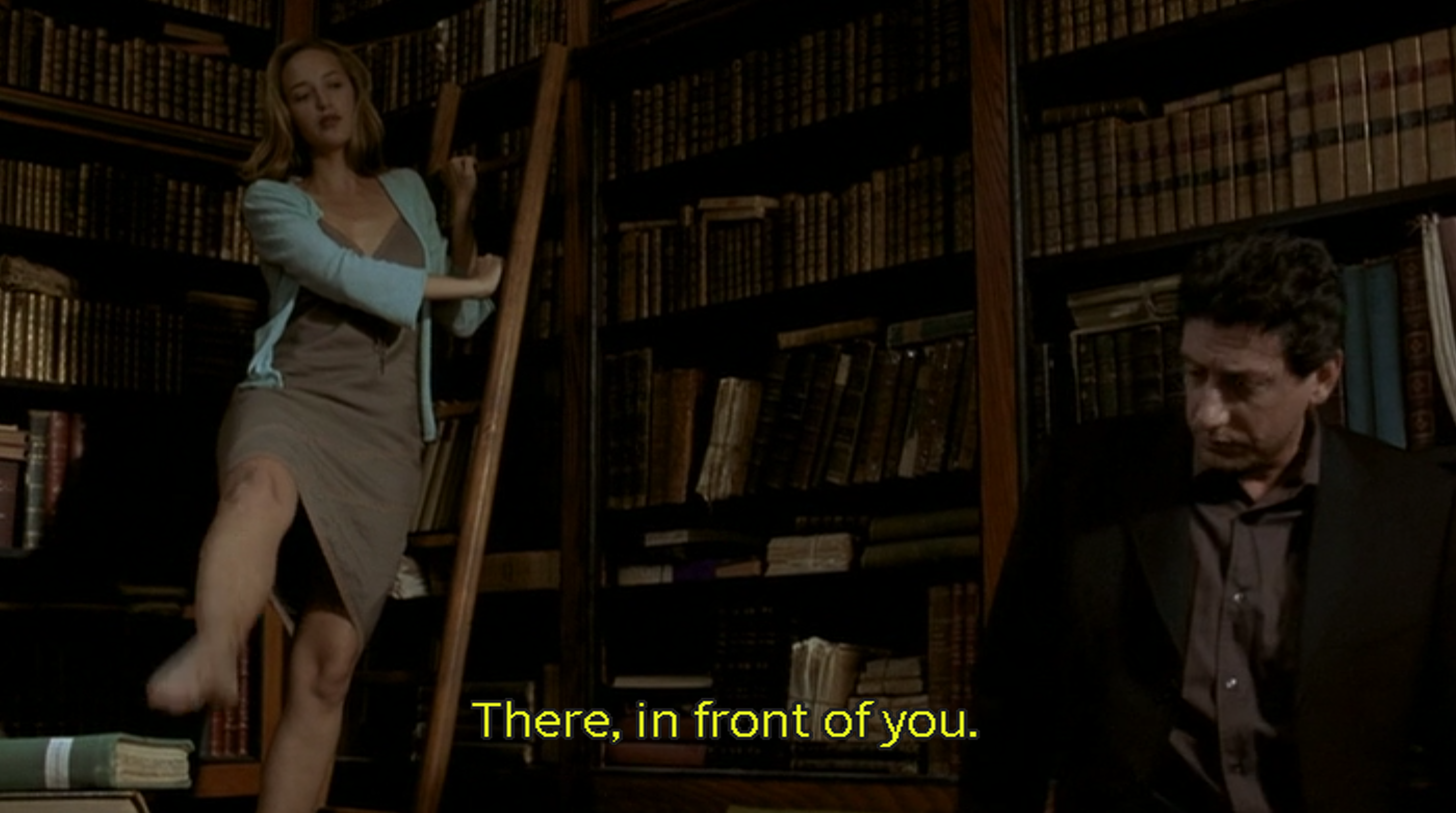
Think of it as a drawing, or a lace pattern, since this is what it feels like as it unfolds in Rivette’s seasoned hands. A sort of screwball moderne, unhurried and ambivalent, where smiles emerge half a second before the cut. It is fine work, intricate in its build-up and fleetingness. Nothing is delivered with a heavy blow, but rather brought about with the beat of butterfly wings.
At the heart of the film are a mystery, a treasure hunt and a play, all of which can be seen both literally and metaphorically. Camille can be understood as playing herself, but everyone else seems to relate to characters in the play too, as they appear in the theater one after the other, night after night. Ugo’s quest for Goldoni’s missing manuscript is as charming as it is indicative, since he seems to find Dominique at the core of his bookwormish wanderings. But what really happened three years ago? And what has changed? Not to mention the obvious question: Why did Camille end up on the roof?

As is the case in Hollywood screwball too, Va savoir is about understanding one’s place in the world as shared with others. Hence all the crossings from world to world, wormhole to wormhole, library to street to stage to dressing room: all doors are portals. It is the magic of contiguity embodied. And how marvelously embodied it is, moving and flowing along in carefully choreographed bodies, none more magnificent than Jeanne Balibar’s arched, slender queen of the treetops bending as if in the wind, never breaking, but gracefully dancing ever on and on. Through their motions, every space is connected to the next, and thus constantly crossed, passed through and metamorphosed by these explorers, adventurers, these living. What makes change possible? What is change, if nothing, not a single molecule, has in fact changed? As the film progresses, it increasingly abandons realism for its surrealistic counterpart. It’s a gentle run down the rabbit hole, with characters uttering what the Mad Hatter or the Caterpillar might have done, e.g. Pierre: “What I say three times is true.” Likelihood is not what makes this world go around. Appearances, entrances, are – leaving ample space for us to question our own seeing and reasoning, our belief in the presence of meanings. Let’s speak to ourselves as Camille does, as in a magic chant: “It mustn’t. I can’t. I mustn’t.” or later on: “I will see you. You won’t be there.” And let’s count fine adjectives for this more than fine spark of cinema: Droll. Serendipitous. Gracious. And utterly, simply divine.