A Conversation with Els van Riel
By Teoman Yüzer & Théo Noël Severin
Following two screenings of Els van Riel’s films on 16mm at exf f. – Tage des experimentellen Films Frankfurt, we sat down with the Belgian filmmaker to discuss some of her work. The first half of this conversation was conducted as part of a Q&A after the screening of Fugue, A Light’s Travelogue and Elliptic. We then met up the next day, to continue where we had left off the day before.
I’ll start with a question about the very ending of Elliptic which is also connected to Gradual Speed. There’s two dedications. I think it was to Vladimir Shevchenko in Gradual Speed. Maybe you can say something about those two dedications.
Shevchenko was a Russian filmmaker who worked for television near Chernobyl. And he was the first who was on the site after the disaster to film. His film survived, but he didn’t. He died one year later. And when I was working on Gradual Speed, it was all about film on film. The material of film and how light is the chemistry of it and how it works, the photography and the writing of light on film and then also other chemical elements that imprint dots and spots and things on film. Like for instance the radiation of a nuclear power plant. And when I was working on it and thinking about all these materials and matters, I came across him. And thanks to my connections within the music world where people dedicate pieces of music to people that are important to them, I thought I’m going to do this in the film as well. Just for him, so that sometimes, we can talk about him and have him there again for a short moment. In Elliptic, when I was working on it, my mother passed and so it’s my mom, aged 93, so she was very old, but still. I could not leave her out. And then this phrase by Paul Celan—«Wie du dich ausstirbst in mir». I found this one of the most beautiful phrases about saying goodbye to someone. We all know that if someone dies they become big. It’s as if they take over for a while and that’s mourning and you have to live with this person not being there anymore. But he or she becomes almost part of you and then it’s as if he or she from wherever they are, they very actively die out in you to give you more space for your life that is still going on. It always makes me emotional. And I find this really strong that the dead give us time and space to continue with our lives.
You mentioned your connection to music and I was wondering about sound in your films. What can you maybe say about how you work with musicians or composers? Do you have very concrete ideas that you bring to them or is it more collaborative?
I always take a lot of time, which is wonderful. It’s not that I make a film and there’s a deadline and I say «Please, make soundtracks for it». It’s not how it works. With Fugue, A Light’s Travelogue, I collected all this information and drawings and formulas and stuff and I filmed things and I thought about how to make a film out of this. My way of throwing everything together in a pot and mixing it and then see what comes out was, I think, a space, a screen, eight projectors, and a camera in the middle, re-filming the projection of the eight projectors. So I had films of three minutes running in it. I had loops running in it. And I improvised actually, always with a countdown to start the three minute part and then running from one projector to the other to switch them on and off and then see what comes out. And then I recorded three minutes of this improvisation, had it developed and printed and then this print was part of one of the eight projectors. I did this eight times. So in the end, there’s only mixtures of these improvisations on top of each other and then for every recording I zoomed out a bit to make the space part of the film. Then, there’s also the daylight coming in through the window in the end, wiping everything out. After filming all the loops and developing them and having everything there, I rewinded. I had to rewind all the three minute films. So, most of the soundtrack consists of the rewinding. All people who sometimes rewind film know that it’s really a rich sound, the sound of film going from one spool to the other, depending on the plastic or metal, with film touching the border or not. So I spent, I think, a day with the sound recorder somewhere in the UK to record these sounds. And it’s a wonderful thing to do, to use a rewinder as a musical instrument. And then this friend of mine, Stevie Wishart, plays the hurdy-gurdy. She’s an English composer living in the UK and Brussels. Next to playing the viola, composing and singing, she also plays the hurdy-gurdy. It’s an old instrument with a wooden wheel and strings and you have to turn the wheel. I thought it might be nice to put this turning together with my technical sounds. And then in the end, I thought I’d write this text and have other friends, composers, helping me to record this voice, singing the lines in homage to all the scientists that have been trying to understand what light is.
And then Unwritten Page was actually commissioned by an ensemble for New Music in Brussels called Q‑O2*. They asked filmmakers to choose a piece of music and to add an image to it, in response to everything related to video clips at the turn of the twenty-first century. I found this piece by Antoine Beuger, who lives in Düsseldorf. He has a minimal music label called Wandelweiser. The people who are involved in this label, they’re all working in the field of the time after John Cage, the question of what we can do after him, with the whole history of music.
For Gradual Speed, I asked my friend, the composer Chiyoko Szlavnics, to think about the soundtrack for this film. And then it was she who said «Els, I know that you really love the sound of the start of a film, the sound of the material. Why don’t we use this sound?» And there’s something about it, the lights go out, you hear the sound and it’s the sound of something new starting. Somehow, it’s like the sound of expectation for me. And it’s not just the sound of the projected print, but it’s actually the sound that I recorded from the work print, so it’s more dirty and you hear the splices and the difference between white and black. Chiyoko Szlavnics has been working with instruments, orchestras, but also her own language for 20 years now. She added a few sine waves to it. Maybe you heard them. I always hear them. And then for Elliptic, thanks to the Wandelweiser people, I met Marie-Cécile Reber and she makes little narratives with sound. She’s a composer and pianist who lives in Luzern. I asked her if she would be interested in thinking about what the sound of light itself would be. Like, what would you put next to or under a beam of light? And then only months later came an email saying «I was watching this beautiful light coming through the window of my studio. And then I was thinking and I started recording something and I think it has to be a high pitch but maybe vibrating a bit.»
So then we started the conversation about the sound of light. And I collected more and more of these images and then I also found a bit of a budget, so a teammate and a soundtrack. I think the level was still a bit too high today. I will go down a bit more. And I must say the thing that I really want to keep on working is this way of being totally slow and having weeks in between one sound and the other. And then when you have time to sit together, we sat together for the last film with Marie-Cécile. I went to Luzern and we spent the week together, we listened, we tried other things, we decided nothing and then said okay, next time. So that’s my luxury of having time.
So, about time, I was wondering, especially with Elliptic and Gradual Speed, about shooting at these different places and trying out these techniques. I imagine there’s a lot of trial and error involved in choosing different motifs to shoot and then deciding afterwards which ones work or which ones don’t.
For both films, there are some takes that didn’t survive the editing but I think mostly I take my time, to really be somewhere. I only film when I believe this can be something or become something while filming. And that’s what I’m trying to do when I’m recording, just sitting there, having the camera running, being really present. For Gradual Speed, I very slowly had to change the speed of the camera from 2 images per second up to 24. So, for some takes that last like 10 minutes here, it takes 25 minutes to shoot, and I sit there turning one knob. For Elliptic, the amount of time is the same as projected, and the longest one is the one with the little beetle. Seven minutes, I think. I sit there for seven minutes, just slowly, slowly changing focus to go in and out again. For me, making films help me be in the now. As if we are capable of stopping time from time to time, to try to understand what we are doing here. Life and the world, and film being able to reflect on the world, what this is about and I would love to, before I go, understand something. Or just have the right feeling about it. That’s an ongoing process we all go through, right? Some people say that my films are meditative. I really don’t know what meditative is.
A question from the audience: «I was wondering about the relationship between scientific film and experimental film. Because I think both of them, they reflect some things scientifically, they both work with an exploration of the material basis of film and filming, the camera and light. So maybe could you say something about your perception of the relationship that you see between experimental film and scientific film and maybe even the filmmaker and the scientist? Is this something that you thought about?»
Sometimes I would have loved to be a scientist more than being a filmmaker, because they have the language, which is mathematics, to try to point out pieces of reality. The real scientists, not the scientists that take science to sell in some kind of application, but people who are trying to find what energy is about, what light is about, what the sun is about. Filmmaking comes out of their knowledge. They create the tools to look into the universe, to look at small things, microscopes. They were there before film existed and before photography existed, to make lenses and to make the tools to try to dig into pieces of reality. The real physicists would try to understand what life is about. There are still these big questions like what is the border between inorganic and organic chemistry, where did life begin, for instance, out of inorganic materials like stone and water and stuff and then suddenly there’s a little animal that moves around and it almost has a spirit, like a living, biological creature. All these questions there, they have no answers yet. These kinds of questions are still out there and it’s all about the magic of what life is, no? We’re human beings and we address them. We invent cinemas and we invent photography and we invent the digital world.
For Fugue, A Light’s Travelogue, I went to the University in Ghent because there’s a LumiLab. I thought in this lab all the professors and the scientists would be able to explain to me what light is, they are much further advanced than what I can find in books and on the internet. So I met the director of it and we had a long conversation and I asked him, please can you explain to me, nowadays, how far are scientists into the knowledge about light? And he said, well, that’s a philosophical question. So he couldn’t answer. And he said, actually you’re right, I dedicate my life to something that I don’t really understand. So I went to the philosophers and they said, well, if you want to know what light is about, then you have to go to the scientists. But it’s beautiful. It’s all us, it’s all people, it’s all filmmakers who take bits like me, bits of knowledge to share and to be able to talk about it. Al-Hasan, in the 10th century in Iraq, it’s him who wrote the first book on optics because he was asked to, in Egypt, to work on the Nile and to construct a system to control the river, to have it flooding the fields around to have harvest. But he, in those days, he didn’t manage. And then he was imprisoned, he was punished, and he was sitting inside, and then he started looking at the window. And then he discovered how light breaks on the borders of the window and how it reflects on his metal plate. And he started looking at the reflections. And he started writing about optics and also what happens in the eye. The old Greeks, that’s poetry, and it’s also very beautiful, thought that some of the radiation of light comes out of our eyes. And our eyes give light and reflect on things, and then it comes back to our eyes and our brains, and that’s how we see. And we say that when someone dies, the light goes out in the eyes, so it’s still there. For me, education, there’s many good things, but also the division of poetry and science and film and art. And it should not be devised like this. I like to bridge all these divisions again. Sometimes, someone who makes a projector, they are more of an artist than some art I see projected. To make the machines and to understand how it runs, to keep it running and to make sure that it’s running well. So, I would love to see all these divided knowledges being mixed again and that we talk to each other, that the poet can talk to a scientist and that we find the same language that we both understand, because I don’t speak mathematics and other people do. In my next life, I want to study mathematics, because it’s a poetic language. It’s beautiful that people dedicate time and energy to both, and sometimes I like to not see the difference. But of course there are differences.
Again, mostly related to Elliptic and Gradual Speed, I was wondering about your way of structuring the different shots in combination with each other. Do you already know before you shoot them or is it something that you do later, again with more time?
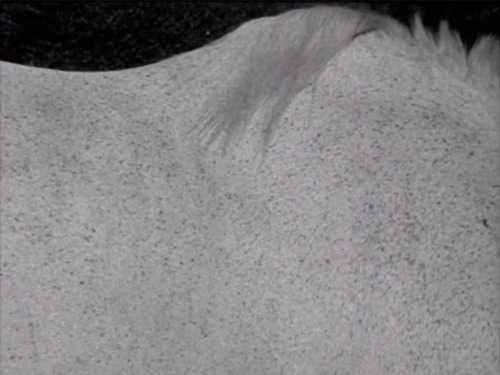
It always just starts with this idea of digging into pieces of reality with a technique. I collect a few and then I live with it for a long time. I have them in my head. Sometimes I make a clipboard with titles, all the images of titles. Then one day I put it in this order and then one day I put this one out and then next day I put it back in. So it’s all about lots of time. For Gradual Speed when I filmed the horse moving its head, from the beginning, I thought, this is the first shot. Then every shot finds its own place over time. At some point I also had an invitation for this film. Someone who runs a film festival in Sweden saw some of the images and he said, if you ever finish it, I will invite it. So suddenly, I had to think about finishing it as a film that will be shown. And after a while there even was a deadline, and then I worked a bit faster. I really wanted to end with white so I was looking for snow and snow landscapes, so there, I was really going with a certain idea in the back of my head.
The following day…
It sounds like a very abstract question, I’m trying to get to something concrete. I’m interested in what value you see in structure. Because if I were to describe your films, there’s the one sentence description, which is like Gradual Speed is a film where you gradually increase the shutter speed. But then, if you actually watch the film, it seems like in every shot you try to break that rule. Like you make yourself a rule, a traditional structuralist approach, and then it feels to me like the rule exists to break it at every opportunity you have. So I’m interested in what value you see in even having that structure to begin with.
For me, the structure is a starting point only. And with any work that you do, you have a starting point, like a road to start from, and to see your road is a structure. I can go there with this system, with this camera I use this system, this technique, and then, when walking the road, it’s so nice to, you used the nice phrase «break the rules», I would say «fuck the rules» or something, but you have to go against it, because on the road there’s this need for it and you find new things. For instance, in Gradual Speed, after a few recordings that I really liked, I thought the image comes in too quickly. I wanted to slow it down. So I started reprinting the negative on a contact printer where I slowly added light to the printing. And so I could manipulate the speed of the becoming of the image in printing. But then of course to edit this together with the original negatives of the other tapes, I had to make an inter-negative of this print and the quality is not the same. And then you see these two qualities of photography, and then I started playing with this. There are sometimes cuts to one film that is a bit blurry and not really in focus and then cuts to the really clear, photographically correct image. There are new structures coming in, following this one starting point. And it’s so nice, while working, that you always find new ideas and new pieces of language and new means of what your practice is, just by working, by giving it time. So it’s the opposite of writing a scenario and then copying your scenario into reality.
In your films, there are these moments of an illusion or something that is not quite as it seems because of a technical effect. I was wondering if that’s something you think about when using a technique like changing the shutter speed or is this rather a side effect that maybe you can’t make out the image at the beginning.
Actually it goes back to when I was a kid. Swapping eyes, from one to the other. It’s different, like you sit now, when I close my left eye, with this pillar on your right ear and now, when I close my right eye, it’s on the other ear. So I have the power to make you jump. And I did these kinds of things in class when I was bored, making the teacher jump. So it’s about this and about how every little detail, where you put your camera, is really important to make an image. I made a series of photographs where there’s an object on a plate, and I put the photo camera in front of it, and then I move it just a tiny bit, and it changes the object into something else. Not really, but it’s about the message behind this, watch things twice before you decide what to see. It’s a really boring message, but the fact that this viewing position is not the same as this other one, it’s a huge difference. We need to look around and have different points of view before we make decisions.
How would you describe the difference between Unwritten Page and Gradual Speed? If you just look at it briefly it would seem like it’s an image that turns from bright to dark. I would assume that for you it’s very different, the effect it has on perception.
Unwritten Page hasn’t been shown for a very long time. It came out in 2000, Gradual Speed came out 13 years later, and I almost forgot about Unwritten Page, and only afterwards I said, actually I already did this. So, it’s not consciously connected. Unwritten Page is actually based on the question of what I want to see on the screen. So I started with the screen that appears slowly, so you have the screen and then this idea of, especially with 16mm film with its curved and unsharp borders, it’s as if you’re looking through a window and the image that you’re projecting is behind. When the focus is on the image and the border of the projection is always unfocused, there’s this depth going on. I love the idea of an image coming from the projector. It was actually a friend of mine who saw it like this. The images in the projector go through the screen and then you see it behind the screen. With Unwritten Page, it’s slow movement from the projector to behind the screen. So the screen appears. And I did film through the canvas that is a bit translucent. Gradual Speed actually has nothing to do with the canvas anymore. It’s about wanting to have images appear slowly. And because just closing the frame was not enough, I changed the speed. And then I saw that also during the speed changes, you can play with it. It becomes like an instrument of the film. Because the speed of the images change. Like the image of my mother’s hands, the nerves and the breathing, it’s calm at first and it speeds up. So there’s a difference, because there’s something added to it due to the change of the speed.
You do usually work with slower rhythms but I found it so interesting that the film you projected in Fugue, A Light’s Travelogue was very, very quick and there were a lot of things happening.
The rhythm comes from the recordings I did with the flashlight. The question of how dark do you have to go to see light? That’s in the back of my head. Only in darkness do you see points of light. So I started recording in the dark at night. I switched on the camera and then with the flashlight I would go around some objects to have the difference of light on something. I used these as the beginning to add all the other layers on top of it. It’s just light flashes.
So it’s one continuous shot and you flash the light?
Yeah. Because when I film on my own, there’s nobody else who can switch it on, so I switch it on. You lose a lot of film on this black but it’s so nice to do. It’s a nice color, too. It’s almost like painting with light, to go around something, and flash the light quickly, and then it appears and then you can construct a thing.
It seems like a different working method than usually.
But also, Elliptic is different. It’s always a different starting point. In Courtisane this year, I made this piece for the 360 degree projection thing and there, I have very slow movements of the camera. What I was talking about with our eyes, we jump, jump, jump, we never do a continuous movement. With my next film, I might go in that direction with panorama movements and then bump into something.
I would like to ask you what is it you do all day to live? What kind of work do you do? I assume you don’t live just from your films.
What do I do during the day? I live in Belgium and we have the advantage that we have unemployment money for artists. So every year, I have to prove that I work as an artist and have invitations to festivals. On top of that, I teach a bit in workshops, working with film, with young people and I also work for friends who are filmmakers. I do camera work, like real photography and putting together light and stuff. Only for friends and only projects that I believe in. I would never go somewhere for some commercial thing. I can’t stand it. That would take all my energy. Like, this summer, I worked for Annik Leroy. I did some recordings with a good friend. And their work is photography. I love to just do good photography. Like, how dark can you go, how bright can you go. And another job, to go to Denmark to film horizons on the islands, is like a paid holiday, actually. So these kinds of jobs come. I also set up installations. For example, there was an installation with 15 projectors and 15 loopers. The loopers I constructed, the projectors I bought, and I still have them, and I rent them out. So, with this also I make a bit of my living, and I can also pay for my own work. Because I write applications, that’s also a big job, also for the artist-run film lab where I work together with others. It’s always writing applications to be able to pay the rent. That’s where I teach as well, that’s where I sometimes do my development stuff. When you write applications for the Flemish Film Fund for instance, you have to add a percentage yourself. So therefore, I need to do jobs for different people. I survive.
Do you see this as separate from your art? Or true to what you said yesterday, that you shouldn’t separate art and science and work, is it like that for you?
Art and living and breathing, that’s all the same thing. For me, art is as important as a hammer if you want to put the nail in the wood. You need a tool. And for me, art is a tool and a language. It’s just as important as a potato. We need it to feed ourselves, to feed our conversations, our brain, our way of looking at things, our love for life. Otherwise we kill ourselves, no? And without potatoes, you also die.