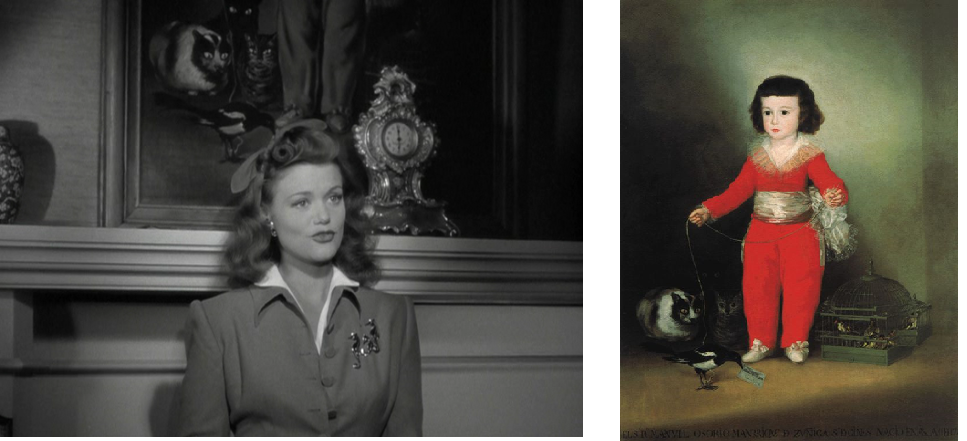

The concern with this particular shot must have crept in at some point after having watched Jacques Tourneur’s I Walked with a Zombie’s perplexing last four minutes for the 13th time. It was part of the process of getting prepared for that wonderful weekly gathering at which we discuss the films of Val Lewton in an extremely frigid building. If I was expecting to find the tools to encrypt the film’s last minutes, I am very glad to say that I did not. I Walked with a Zombie remains to me as beautifully ambiguous as before.

Nevertheless, something about the composition of this particular shot troubled me. The rocks surrounding, the exit to the sea, the figures seen from behind, all seemed somehow familiar. I suddenly thought of Arnold Böcklin’s Isle of the Dead and, though it may be ridiculous, I did not at that moment ask myself why I recalled this particular painting with such ease.

Putting the images side by side (they had by then multiply mutated – I had paralyzed the shot from I Walked with a Zombie into a screenshot and I had picked out an image of one of Böcklin’s versions of the painting online) firstly resulted in sheer disappointment. In my attempt to compare them, I was looking merely at the shapes. Yet then I realized that looking out from the shore (a change of perspective, the counter-shot), the exit from the Isle of the Dead would look very similar to what can be seen in the shot that concerned me so. (If this is an attempt to escape from the Isle of the Dead, does it succeed? Is this absolution or damnation? Is the ending the victory of the rational or the irrational?)
My comprehension of the connection between the setting where the ‘action’ of Zombie is supposed to take place and the isle of the dead was by that time perhaps long due. Firstly because the painting (a reproduction thereof) can be seen earlier in the film, secondly because, of course, Lewton produced, a few years after the completion of Zombie, Isle of the Dead, which deals more explicitly with Böcklin’s painting.
Though the island of St. Sebastian in the West Indies, the diegetic setting of I Walked with a Zombie, does not seem to exist as an isolated island, there is an island called Santa Clara which appertains to the Spanish municipality San Sebastian and it was to this island that the people of San Sebastian infected by the plague were transferred to in order to keep the infection from spreading. In Lewton’s Isle of the Dead the island is also presented as a place governed by the plague.
After having finally gotten a grip on the connection between I Walked with a Zombie and Arnold Böcklin’s Isle of the Dead, it still seemed a bit far-stretched to accredit this awareness to the composition of this particular shot I had started from. I considered consulting the script and ended up doing it. The scene was not shot as described and, when I found the approximate spot I was looking for, there was no reference to Böcklin’s painting. I faced disappointment once more. Yet looking en passant at the following pages, I stumbled upon this

I did find some comfort in the confirmation for Zombie turning to (Böcklin) paintings to draw inspiration for the composition of the shots, so I continued following the trace. Once more, the scene had ended up being shot differently than described. My superficial search for a Böcklin painting named And the sea gave up its dead was futile, although the painting might very well exist. However, there is a painting by Lord Leighton Frederic entitled “And the sea gave up the dead which were in it” (and having this Bible-quote to put in relation to the film did give me some satisfaction). I had chosen an image to fit the approximate spot described in the script, put the two images side by side and was, once again, disappointed.
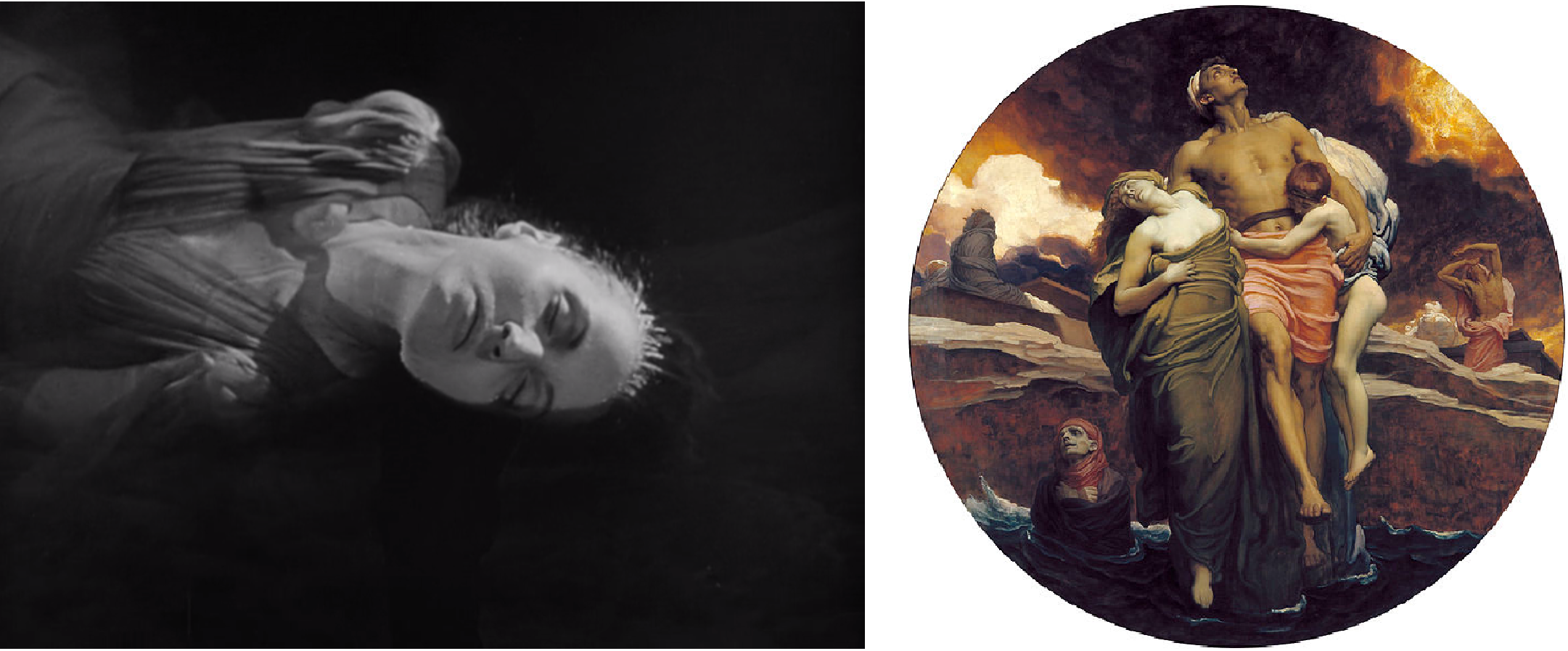
I kept scrolling through images of the paintings of Böcklin until stumbling upon several portraying Triton and (a) Nereid and assumed that it was one of this paintings that was intended to ‘somewhat influence the composition of this scene’. I also assumed that ‘this scene’ ended up in the film as this dissolve that makes my heart skip a beat.
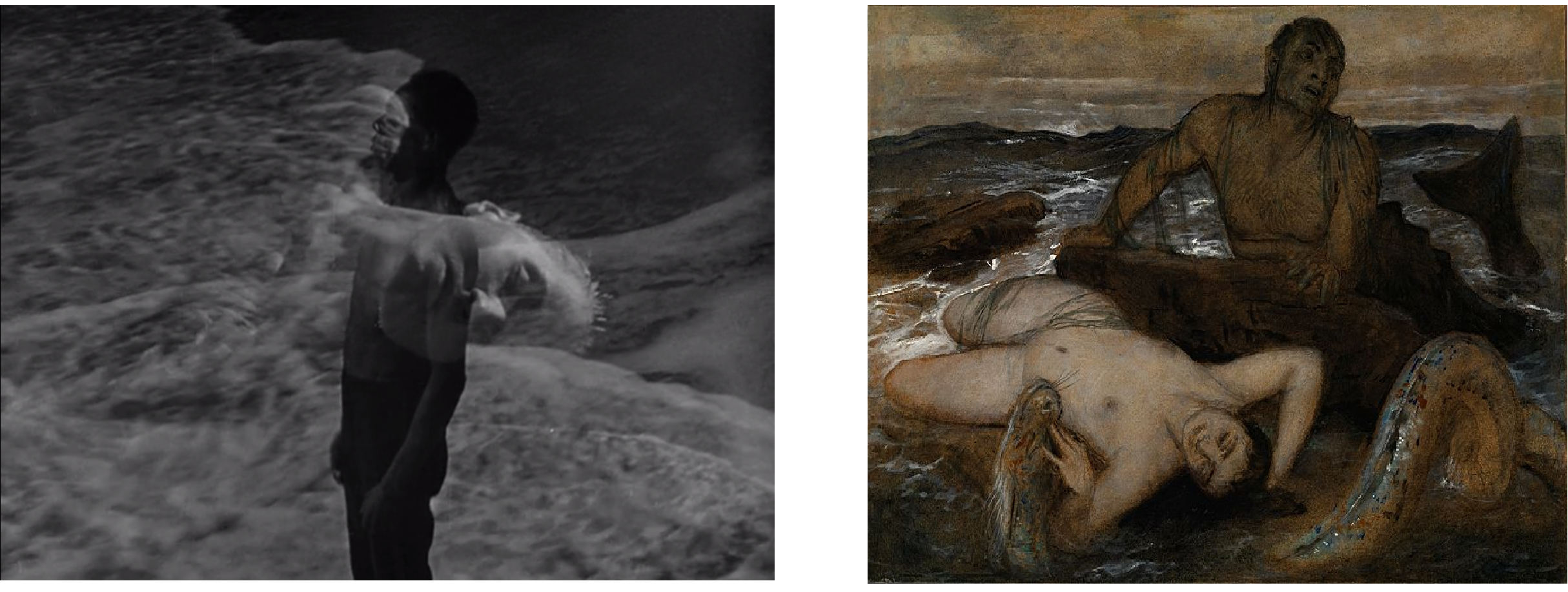
I found a connection between Triton, messenger of the sea and Carrefour, also a messenger (but of what?). And then I imagined having found a connection between Triton’s trident and the tools the fishermen use when looking for Jessica’s body, tools that the script described as spears and ended up being very trident-looking. It also seemed natural for this scene’s equivalent of a Nereid, a protector of fishermen, to be found by fishermen. If nereids are usually represented as beautiful barefoot girls wearing silk gowns, it seemed only natural for Jessica to be presented in the same manner. (If the Nereids symbolize everything that is beautiful and kind about sea, does Jessica’s death put an end to the putrescence previously associated with the sea? Is the death a death?)
At that point I, realizing that I will not find enlightenment, I stopped following and remained blissfully perplex. Of course, there is also this and perhaps much more: