

This text is an edited and translated mail I have written to a friend a day after having read Les Yeux Verts by Marguerite Duras and without being able to re-read it or check certain passages. During the last couple of days I was confronted with the book again, so I decided to publish this.
When Marguerite Duras was given Carte Blanche by Cahiers du Cinéma in 1980, out came a somehow incoherent, somehow beautiful and always vibrant collection of texts called Les Yeux Verts. In it many things are discussed such as politics, the ideas of writing and cinema («My relationship with cinema is one of murder. I began to make movies in order to reach the creative mastery which allows the destruction of the text. Now it’s the image I want to affect, to diminish …») the Soviet Union, Chaplin or a big interview with Elia Kazan. In a great, fearless essay Duras differs between what she calls a primary viewer of a film (meaning: the masses manipulated by capitalism who go to cinema to forget) and the small percentage of people who are not part of that kind of audience. Some might refer to such a view as snobbish but Duras arguments that she and the primary viewer will never understand each other. There is question about what comes first: The author/filmmaker or the critic/viewer. Both at the same time, one is tempted to say. In an interview given in Cannes 2012 Carlos Reygadas was shrugging his shoulders when confronted with viewers who did not understand what his Post Tenebras Lux was all about. He said: „Well, some will never understand. You cannot fight it.“
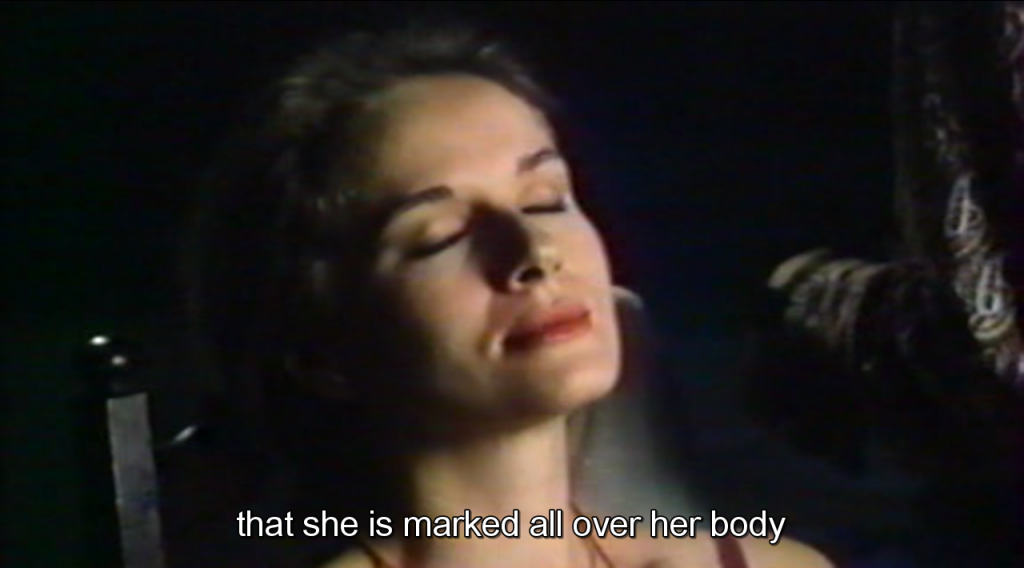
Is this the story of a difference? A misunderstanding? Cinema, as always between the industry and the art, lost and impure. Most cinephiles I know would deny such demarcations. They have their point. You can find greatness in mainstream entertainment, in so-called trash, in art, in art house, whatever. I have always liked the texts by Alexandre Astruc on Howard Hawks, I think you have read them. The way he connects fascism to cinematic greatness with and without sarcasm at the same time beats at the very core of this conflict. Cinema is and has always been both: The money and the soul. The industry and the art. The fascist and the liberal. Nevertheless Duras is right when she says that primary viewers will not be interested in her work. It is the primary viewer that is limited, not the one who makes demarcations. The primary viewer, she says, is also among critics and filmmakers. They account for 90 percent. While she would be happy with her 10%, the filmmaker for the primary viewer would be unhappy with his 90%. He always wants to take away the 10%. He will fail forever, she writes. Duras also states that one is not condemned to be a primary viewer forever. Yet, a primary viewer will not be changed by force. He will have to see something, to maybe fall in love.
Another point Duras discusses in her texts is the idea of curiosity. Maybe this is linked to the primary viewer. Despite writing for the Cahiers du Cinéma Duras stresses her ambivalent relation with the “guys of Les Cahiers“ more than once, thus her relation to film criticism is a big topic. She finds a lack of curiosity in film criticism. She claims that critics are writing only about big budget films, that there is a lack of choice and freedom in film culture. Of course, like in her best texts, out of her speaks the fever of personal frustration. It seems that cinephilia, for Duras, is a sickness connected to a love that loses the ability to see. Cinephilia might be a blindness then. One of those paradoxes but as you know, we have seen this blindness. People ignoring cinema in order to have an opinion. People judging before seeing, without seeing. People watching and watching without reflecting. Is it more important to know what we want from cinema or to not know what we want from cinema?
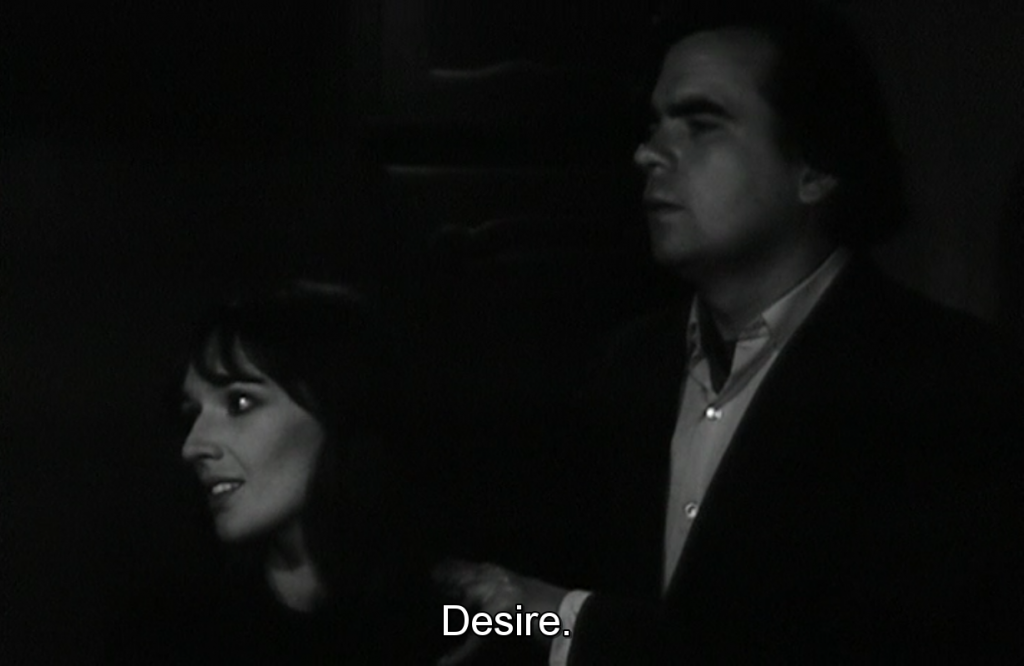
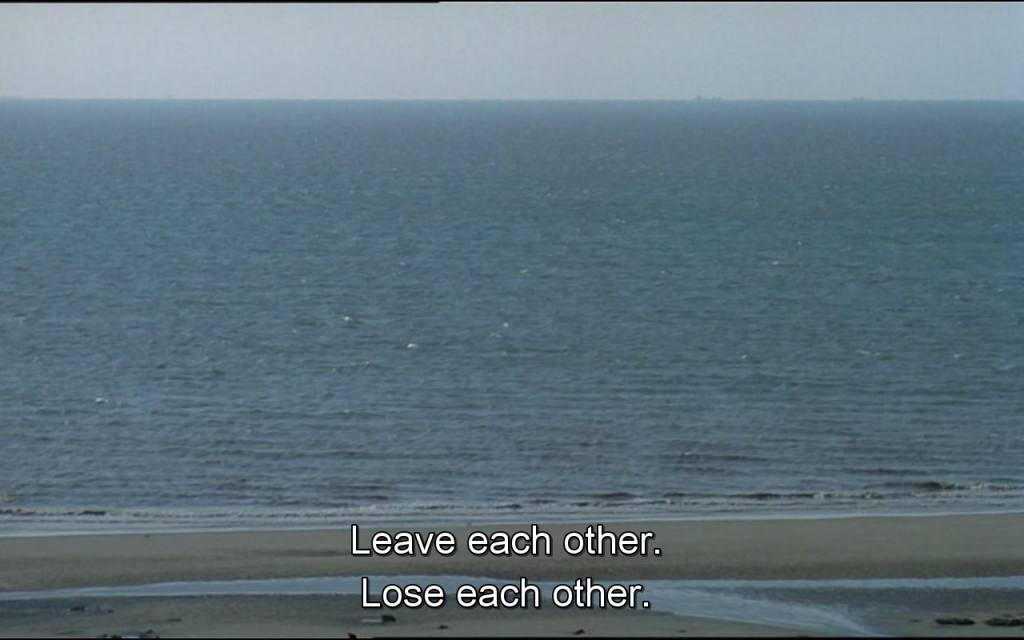
While thinking about her own films Duras writes that they are vibrating, floating. More than once she flirts with the idea of a black screen. Destroy cinema, she said. I have always thought that her inability to destroy cinema (or her words) has been the cause of those floating vibrations in Duras. It is a cinema of impossibility. When her camera looks at the ocean and she thinks about destruction there will always arrive a creation or suggestion. Moreover her women, I can only call them that, seem to live in the same world as the camera, that is between self-destruction, forgetting, loving and so on. She is very much about the not-representation, the gap between the presence of light and the stories that might or might not have happened. Thinking about cinema this way will always lead to the idea of destruction. When she says that primary viewers visit cinema to forget we should not suppress that this is exactly what bothers her protagonists: Either the forgetting or the memory that does not vanish. Once written down or spoken out, her words transform those memories. When you then confront them to forget you will not get anything from it. Carol Hoffman has written: “It is a remembering that destroys memory and leads to a new memory, which can replace the last only fleetingly and without substance “ Without curiosity and desire, how could you possibly bare such a work?
Like Jean-Marie Straub and to a certain degree Brian De Palma, Duras is very concerned with the lie that is part of the word spoken but also part of the images made. These three filmmakers offer three interpretations of the lie in cinema. Straub does everything to get rid of it, De Palma does everything to make the lie the truth (or vice versa) and Duras tears down the difference between lie and truth. Maybe Godard would have a say here too. In one of her texts Duras recounts an episode in which Godard was inviting her and she travelled a long way to meet him. When she arrived he wanted to sit down below the staircase of a school entrance while all the children were leaving school. They talked a bit until Godard said: „Isn‘t it funny. I let you come such a long way to sit down at this place.“ Apart from that Duras felt that both of them were thinking a lot about the relation of text and image with Godard coming from the other side (the image) as Duras (the text). There are also those filmmakers claiming that the word is a lie and the image is not. I always liked how Jean-Luc Nancy linked this thought with the importance of a doubt. Only in doubting the image it can become a truth again. He said that about Kiarostami but it is also true for Duras.
In her texts I can also feel what we have once referred to as the “cinephile loathing“. I don‘t know if you remember. This idea of having had too much while still watching. It is a thirst for something else that ultimately leads us back to cinema. I sense in her writings a desire to not like cinema while being madly in love with it. Especially in her text about Woody Allen that becomes apparent. In interviews she has often said that she does only watch a handful of films a year. I don‘t believe her. We have this tendency with contemporary filmmakers, too. I have heard them say: I haven‘t been too cinema for a decade. I only watch old films. I only watch documentaries. I don‘t watch anything. There is a desire to not be influenced. Jacques Rivette teaches us the opposite. With us, as we discussed, this cinephile loathing might be something else and I somehow felt it mirrored in Duras. The idea that our generation has been betrayed by cinema too often. A silly thought, but still a thought. It is as hard to believe in excitement as it is to believe in doubt. As a result, everything stucks and floats just like the black wall that Duras describes which is between her words and images, makes them vanish. Still, others have told us that it has always been like this and maybe we love and doubt too much to state those things. The cinema writers we read and the filmmakers we love are either embracing the death of cinema or fighting death with knowledge and a suffocating enthusiasm. Both kinds seem to be descendants of Serge Daney of whom we all dream at night. Cinema was always beautiful when it was something else. With Duras it certainly is. I will have to re-watch her films. To not forget.