

It started with jazz, yet some of the films seem to have the blues. The second part of the Austrian Film Museum’s retrospective dedicated to French crime cinema, this time 1958 to 2009, started off last month with Miles Davis’ music composed for Louis Malle’s Ascenseur pour l’échafaud following Jeanne Moreau’s “Je t’aime” whispering face (in Truffaut’s La mariée était en noir a man rightfully tells her – had he been a writer, he could have written an entire novel about her mouth).
The blues some of the films shown (mistakenly) seem to have are both chromatic and idiomatic – the films either feel or look blue. Perhaps it started with jazz because their blue(s) has/have already passed. It seems that it is at a moment when the characters have started to lose even their sadness and the chromatic blue of the films is starting to fade that the second part of the retrospective gets back to the French crime thriller.
The vibrant blue of the sea and of Alain Delon’s eyes while kissing a woman’s hand in René Clément’s Plein Soleil is followed by the sickened blue of the films of Jean-Pierre Melville. (Yet Melville’s films were blue even long before that. Perhaps it was another shade. They started being blue when in that shocking moment of Le Silence de la mer Nicole Stéphane raises her limpid eyes.) Concurrently, even characters seem to have entered a state beyond blueness and darker than it. Perhaps it happens only in the films of Melville. But there are too few reasons in favor of avoiding to regard Melville as the guide mark.
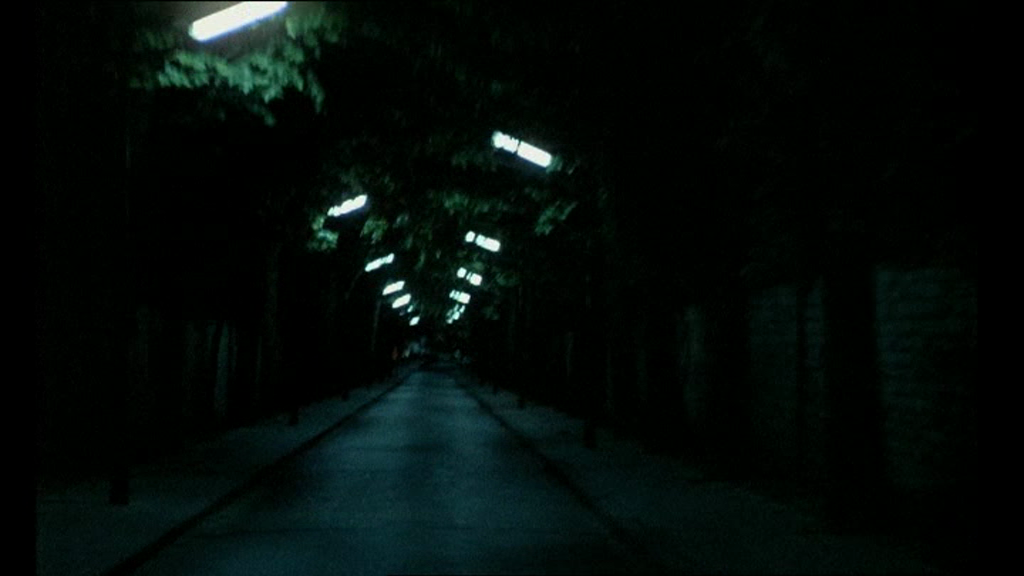
Stronger than ever perhaps, this genre, in which people follow, misunderstand and often end up killing each other, seems to be all about the unbearable pain of human contact and loneliness – that loneliness announced by the Bushido quote at the beginning of Le Samouraï. The dilemma – loneliness is unbearable and contact might be deadly.
Of the killer characters for which contact seems to be more painful than loneliness (and of the films emanating that feeling) perhaps the most mesmerizing is Paul Vecchiali’s L’Étrangleur, who kills because he cannot bear seeing sadness. In the perhaps most pessimistic way of looking at it, the childhood trauma (in Le Boucher, a war trauma) is actually a source of inspiration. However, faced with the great sadness and beauty of the film, one should not bother to define it.
If there is a longing these films prompt, it is perhaps the desire to get a glimpse of those characters› /of those moving bodies› perception (in a sensorial rather than psychological way). Maybe that is also the reason why Delon’s walks through the streets of Mongibello in Plein Soleil are so fascinatingly frustrating. They seem to provide the moments nearest to a glimpse into that undecipherable blue eyed body’s perception the film offers. [Of course many films mirror in their aesthetics their characters› perception]. In a way, despite the verbalization of the strangler’s urges in L’Étrangleur, the recurring vaguely trembling and soundless nocturnal car drives (so Philippe Grandrieux-esque) also feel like that. Perhaps we look at Alain Delon in Plein Soleil like Alex “langue pendue” (Denis “The Dragon” Lavant) looks at Anna (Juliette Binoche) in Leos Carax’ (I feel the title has to be whispered so as not to break the film’s spell) Mauvais Sang.
Both L’Étrangleur and Mauvais Sang (the blue comes back and is more vibrant than ever) emanate a greater malaise. In Mauvais Sang it is spoken of as a disease that kills young people who make love without emotional involvement. Godard’s Alphaville, so intensely close to Mauvais Sang, vibrates with similar threats.

The quest for contact often ends up in the inability to deal with it when found. This seems to be what happens to also Chabrol’s butcher, played by Jean Yanne and the ex-convict played by Gérard Depardieu in Alain Corneau’s Le Choix des armes. The butcher puts an end to his urge to kill others by killing himself. Of course, this sort of character can not only be found in French crime thrillers 1958–2009 it is only that here the chances of the encounters being deadly is higher.
In the darkest of cases, it feels as if these characters who get involved in criminal activity have come to the conclusion that getting a bullet in your gut is the more bearable risk to take, the one necessary in order to avoid the apparently more strenuous process of refusing. Among those many sicknesses (of the spirit) that perspire from the films, the cruelest one is perhaps Todessehnsucht (death wish, in its poor translation from German).
One also finds characters in these films, which seem to get involved with the world of criminality (it doesn’t matter anymore on which side, lawbreakers and polices officers dwell in the same spiritual misery) in order to escape their “habitants du placard” (inhabitants of the cupboard?), as Yves Montand’s ex-cop, (ex-)lawbreaker, alcoholic character, Jansen, calls them in Melville’s quite perfect Le Cercle Rouge. There are quite a few particularities of Jansen’s part that are reprised years later by Nathalie Baye in Xavier Beauvois’ Le petit lieutenant.
Not only criminals and delinquents dwell in this (spiritual? moral?) misery. In some of the films all various sorts of police officers dwell there with them as well. Perhaps the clearest example thereof comes with Michel Piccoli as Max in Claude Sautet’s Max et les ferrailleurs, a film in which the activity of the police is shown as significantly more insidious than the endeavours of delinquents. A similar portrayal of the authorities is to be found in Claude Chabrol’s Nada, in which an unnecessarily violent police intervention against an anarchist leftist group is ordered, just in order to provide a reason to downgrade the policeman in charge of the operation.
Aversions to either the police (the boys in –funnily enough –blue, though they rarely wear it) or relics of blue bloods (as is the case in Chabrol’s La Cérémonie) does seem one of the few forces able to unite characters and shortly pull them out of their passive isolation. In these films the characters regain a strength to revolt and to act (which for example in the films of Melville, starting with Le Samouraï, it feels they have almost completely lost). In Série noire and in Le choix des armes by Alain Corneau the wind of revolt blows from the banlieus, as years later in Mathieu Kassovitz’s La Haine, as in many other films of this retrospective.
The evolution is not chronological, and ultimately all these are variations of the felling even films made in the same year perspire. After all, Melville’s Un Flic (which is not part of the retrospective) and Jacques Deray’s hilarious The Outside Man /Un homme est mort did appear the same year. Perhaps the retrospective started with jazz because saying that the films have the blues is too misleading and simple.