

(Text: Victor Morozov)
“The success of the race was so, that the organisers announced by megaphone that Paris-Roubaix would be held annually, and would take place at Easter, on a fixed date”. Quite a lot has happened in the period separating us from the moment when these words were spoken, some 130 years back. Most of it is now lost in the dust of the cobbles, or treasured in the shaded memories of our fathers and grandfathers. Some of it can still be found in a series of literary works on sport, such as Pierre Chany’s magnificent La fabuleuse histoire du cyclisme, where I stumbled upon this idealistic quotation. As time goes by, causing the dust to be lifted year after year by the stampede of wheels rushing towards a small town in the North, it is these few books that become the passeurs, in the sense that Serge Daney envisioned it – they pass memory, history, and some of the joys, sorrows, and passions that those times were composed of, on to the next generations, hoping someone will still be there to receive the message and keep the flame alight.
There’s a sense of bittersweet melancholy in the town of Roubaix. It is the kind of melancholy that each post-industrial settlement is familiar with, once it is left to feed off its working-class past, as fleeting as the smoke of the last furnace to close. It surrounds you early on, as soon as you get off the subway at the Eurotéléport station. This name has fascinated me since I first discovered Roubaix by foot, some six months ago, during the most epic race edition in recent memory. As if the city administration had merged several nostalgic meanings into a barbaric word that needs to be experienced like a televised clip from the nineties about a European harbour nowhere to be found. Could this feeling of having finally reached the end of the world be encompassed in this strange name, with its resonance of faraway dreams? There is no sea in Roubaix, and the town, for all its centrality on the continent, seems somehow disconnected from the massive flows of goods operating all around, starting in the neighbouring Lille and the Belgian lande that lies, flat and devoid of a recent past, right beyond the margins of the town.
Roubaix is so heavy with memories belonging to the last century – from factories to organised crime – that this acceleration of History, to the point where it becomes invisible for the human eye, left the town in awe, scrambling for its glorious days, when Émile Zola could sit at the railway station and write down the train schedule… I arrived in Roubaix knowing what everybody knows – that it is a frontrunner of sorts as far as French urban poverty is concerned –, and was willing to discover what everybody seemed to forget. I knew Roubaix from when I used to watch, during high school, Arnaud Desplechin’s autobiographic films: back then, “Roubaix” felt like a silky texture, which quite inevitably alluded to a place where dawns are mellow and youth is free. (Since then I revised my enthusiastic judgment on Desplechin’s Trois souvenirs de ma jeunesse, but this vintage aura of his still gets me as soon as I begin to remember.)
Paris-Roubaix is more than a cycling event: it’s common knowledge. It stems from the story of accelerated economic growth, when a town like Roubaix could only go on the up and up, boosted, among other things, by the great inventions of the fin-de-siècle: the bicycle and the cinema, which could only appeal, for their different practicalities, to the worker. It comes as no surprise, then, that the first movie in history should present the vignette of workers leaving the factory, some of them accompanied by their cheap and efficient two-wheel means of transport.
When Dylan van Baarle from Team Ineos Grenadiers entered the Roubaix velodrome – the sports venue that prompted entrepreneurs Théodore Vienne and Maurice Perez to initiate the famous race –, it’s fair to assume he wasn’t carrying the burden of these melancholic thoughts on his lightweight Pinarello model. I believe that, if he – or anybody else, really – had the time to ponder the inner musicality and contradiction of the word “Eurotéléport”, he wouldn’t feel like racing on the cobbles, for their harshness is nothing like a Western Europe elegy. He would probably just want to take a walk on the quiet streets of Roubaix, in the light of dusk, which happens to be particularly heartbreaking out there, with its cityscape opening up on to nothing. But then I also believe that no one at all – from the spectators to the team staff – really had time to think those thoughts at that moment. The noise of the velodrome – an impetuous wave of shouting and applause and emotion – was simply too powerful. Unlike the Ronde van Vlaanderen, which works its way into your heart like a smooth wavelength of enthusiasm diffused generously through the landscape, on fields and in Flemish cafés, Paris-Roubaix has something of a hot core. What else could this giant TV screen installed by the velodrome – with its live broadcast and its desire to monopolize all attention – scream in our ears, if not the indisputable fact that the true action was taking place right then and there?
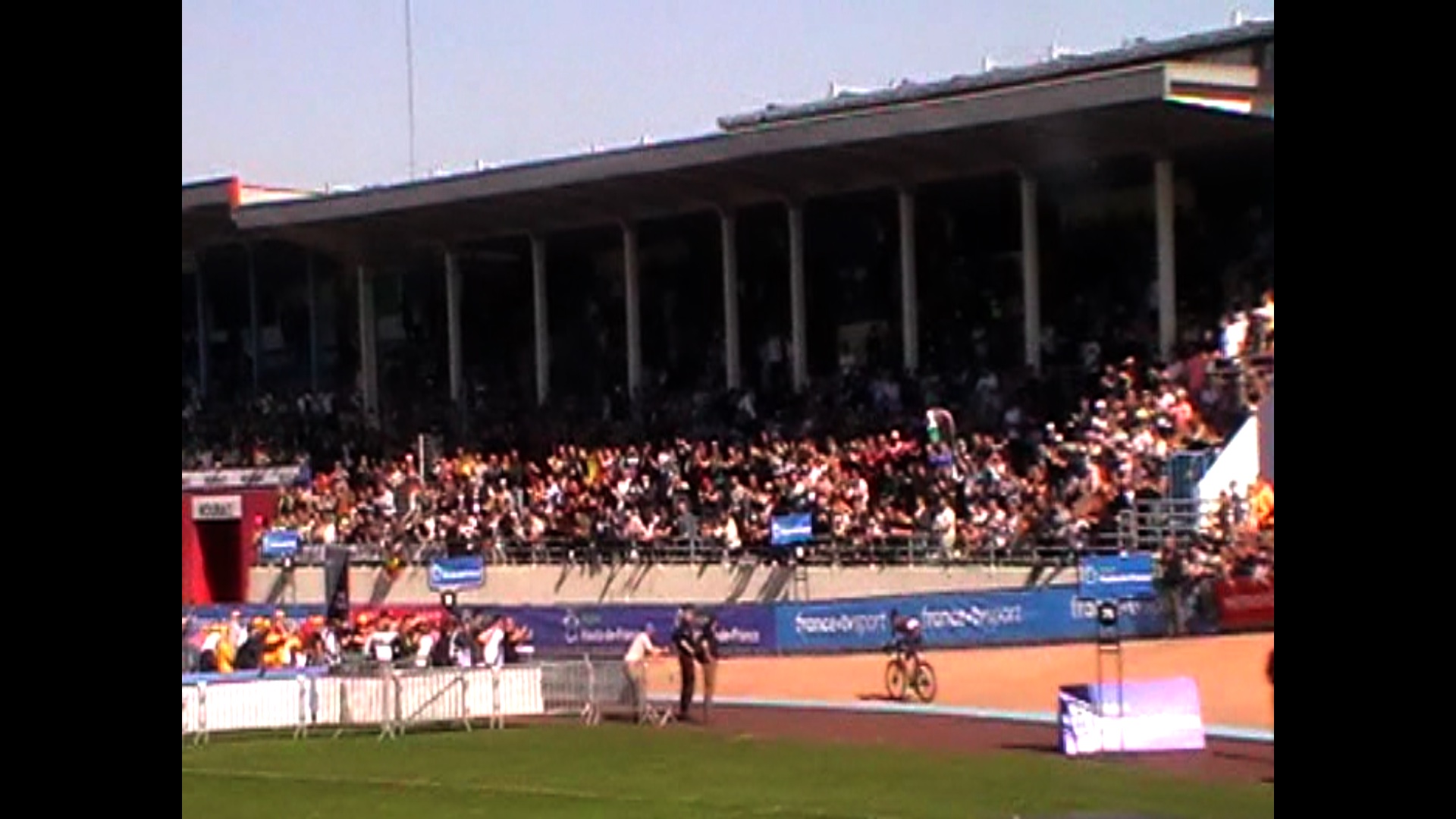
Taking everything into account, however, Paris-Roubaix does seem like the most beautiful race in the world. Its truth is more simple, more transparent, than any other: some 250 kilometres of racing on flat terrain, and that’s it. No artifice – just the sun and the dust, or (if luckier) the rain and the mud. The legs decide who will win. Yet for all this apparent rawness of the mise en scène, no other race has ever embraced so eagerly the myth of the leader, the heroization of the contenders, the epic challenge of the itinerary. The race is hellish, and looking at Pauline Ballet’s or James Startt’s photos from the finish area – faces worn out by physical effort, relieved that it is over –, it does look like the perfect setting for the most basic and universal form of art: one that emphasizes suffering, shattered boundaries of the human body, and the virtue of never ending battle, as if Homer’s heroes were suddenly alive again.
I had been waiting for six months, since that wet, slippery, dangerous edition of Paris-Roubaix, to attain once again that kind of intensity. This Easter edition – the French presidential election oblige – did not disappoint. Never had a plain stage caused more trouble – accidents, innumerable punctures, folded wheels, as if they suddenly became liquid (Wout Van Aert and Christophe Laporte). Yves Lampaert’s mishap, following a slight touch with the arm of a spectator, less than seven kilometres before the finish line, proved once again how cruel cycling can be. I kept rewinding the footage of his acrobatic fall, as he was in second place, watching it in slow motion, decomposing the movement like I was some kind of a cinema pioneer. That body of his suddenly felt very vulnerable as it touched the ground in a fraction of a second, after maintaining the posture of the half-human-half-machine creature for hours on end.
And there he was, reaching vainly for balance, then hitting the ground in the most spectacular of manner, with a gesture so fluid, so helpless, only capable of leaving me in breathless admiration and deep regret. When he finally entered the velodrome (in tenth place), the crowd kept cheering: “Yves! Yves! Yves!”, as a sign of deep recognition: it was a human body that had been put to the test, while up until that point in the race it was the machine, with its more-than-perfect mechanisms, that kept failing.
A final word of appreciation for van Baarle’s deserved win. As Lampaert’s fall summarized a catastrophic spring campaign for Patrick Lefevere’s Wolfpack, so van Baarle, placing almost two minutes between him and Van Aert’s second place, was crowned after a brilliant stint of results at the Classics for his team. As the French say, van Baarle comes from afar – a revenant of sorts. Before taking second in De Ronde two weeks ago, he had been present at the start in Compiègne last October. Yet he reached the finish line outside the time limit, the last one to do so.
I left the Centre de sport municipal, the venue where the velodrome is located. I sat down on a bench on a square, watching kids play football. Paris-Roubaix already belonged to the past. It was unclear whether the melancholy was indeed mine, because the town was now a witness of what the 20th century had been, or ours, because the paved classics season had once again come to an end. The dust had covered the cobbles. It was all quiet on the old country roads.